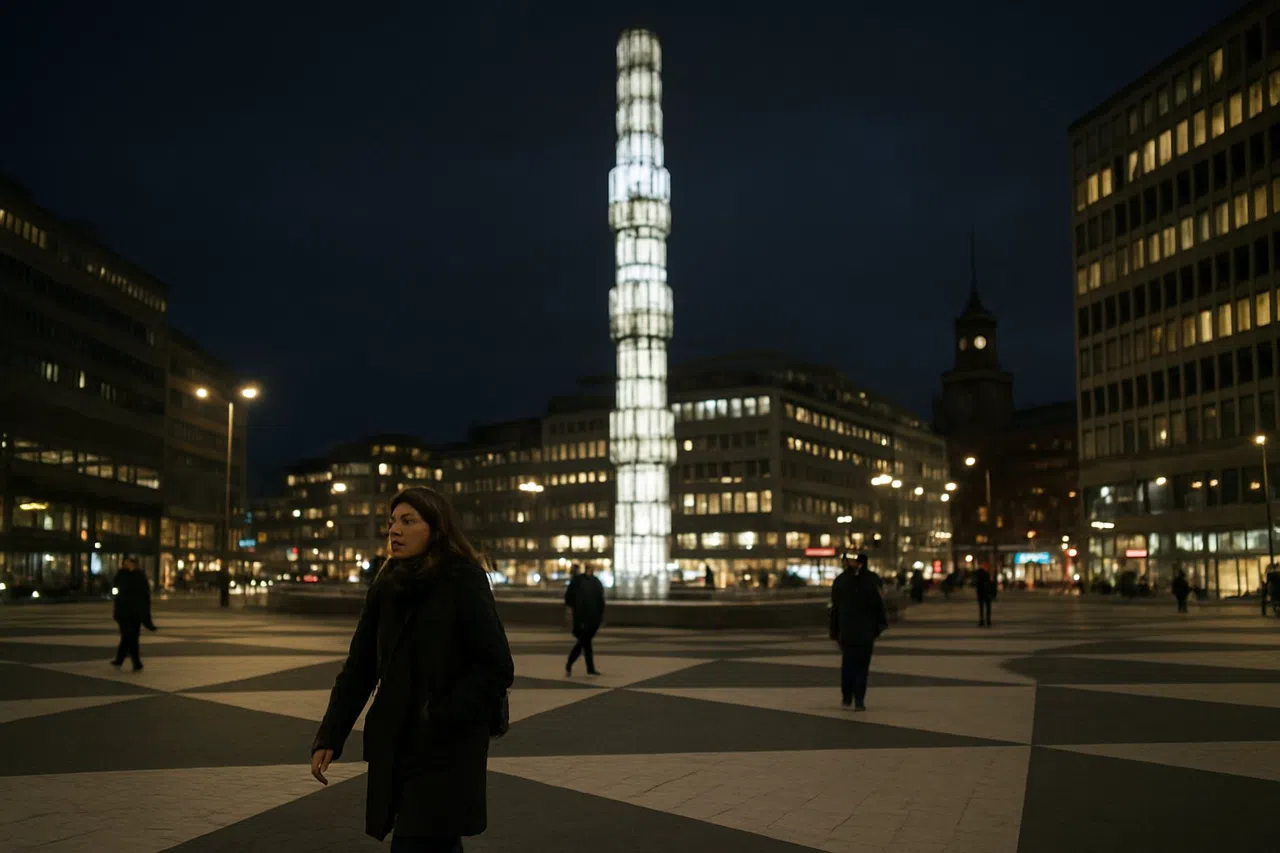
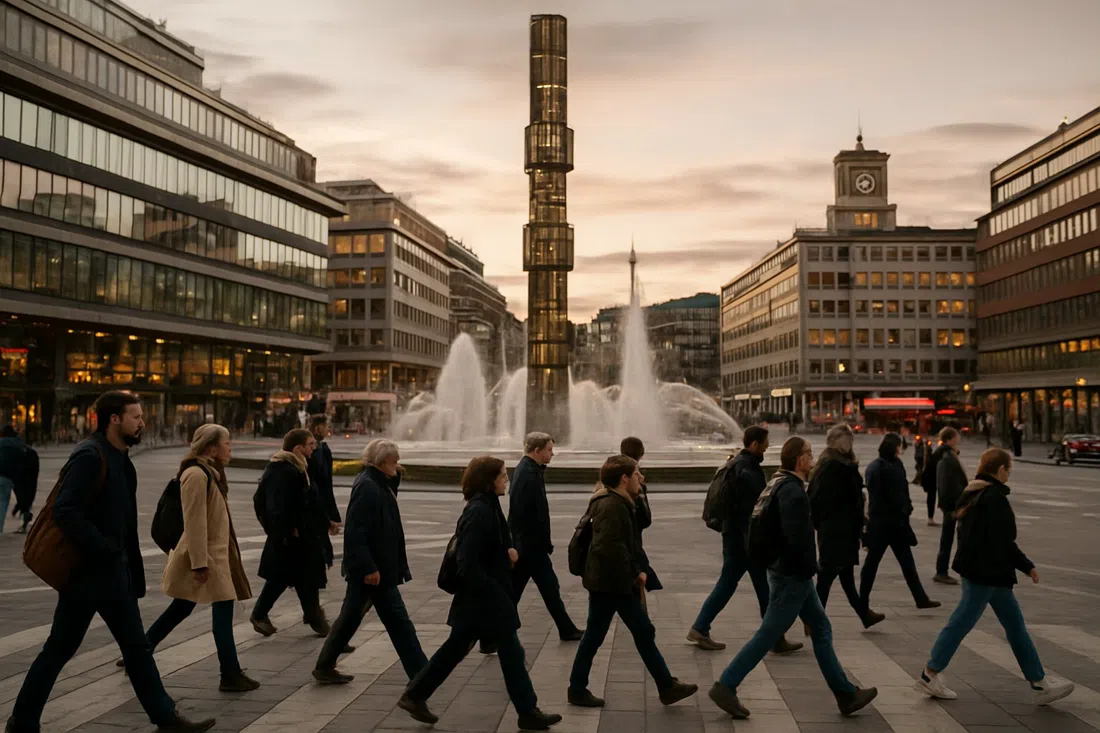
Sergels Torg is already in motion by the time the office towers begin to glow: the 37-metre glass obelisk catches the last light, commuters spill out of T-Centralen in five directions, and the black-and-white Plattan seems to vibrate underfoot with the city’s daily urgency. Norrmalm is not Stockholm’s postcard; it is Stockholm’s mechanism, the place where the city arrives, changes trains, buys lunch, shops for shoes, catches a jazz set, and keeps going. Its beauty, such as it is, comes from usefulness — from the way everything seems to connect, and from the fact that if you stay long enough, the district’s hard edges start to feel like a kind of urban honesty.
A 1960s rebuild that still divides Stockholm
Norrmalm’s centre is a living argument about modernity. Much of what stands here was torn down in the postwar decades, when the Norrmalmsregleringen levelled entire 19th-century blocks to make way for the office towers, shopping galleries and pedestrian decks around Sergels Torg and Hötorget. The result is a district of concrete, glass and elevated crossings that still splits opinion at dinner tables. Some see efficiency; others see loss. Either way, the city’s practical heart was remade here, and the evidence is impossible to ignore.
Sergels Torg is the clearest expression of that ambition. The square is sunk below street level, crossed by the raised, triangle-patterned Plattan, and anchored by Edvin Öhrström’s glass obelisk, a fountain-topped column made from 80,000 glass prisms and floodlit after dark. It is the image most people carry of Norrmalm, whether they like it or not. On one side, the square opens toward traffic and office blocks; on another, the glass-fronted Kulturhuset gives the civic landscape a human scale. The building hosts exhibitions, dance and theatre, and it is free to wander into — a useful reminder that this is not only a place to pass through but one to pause in.
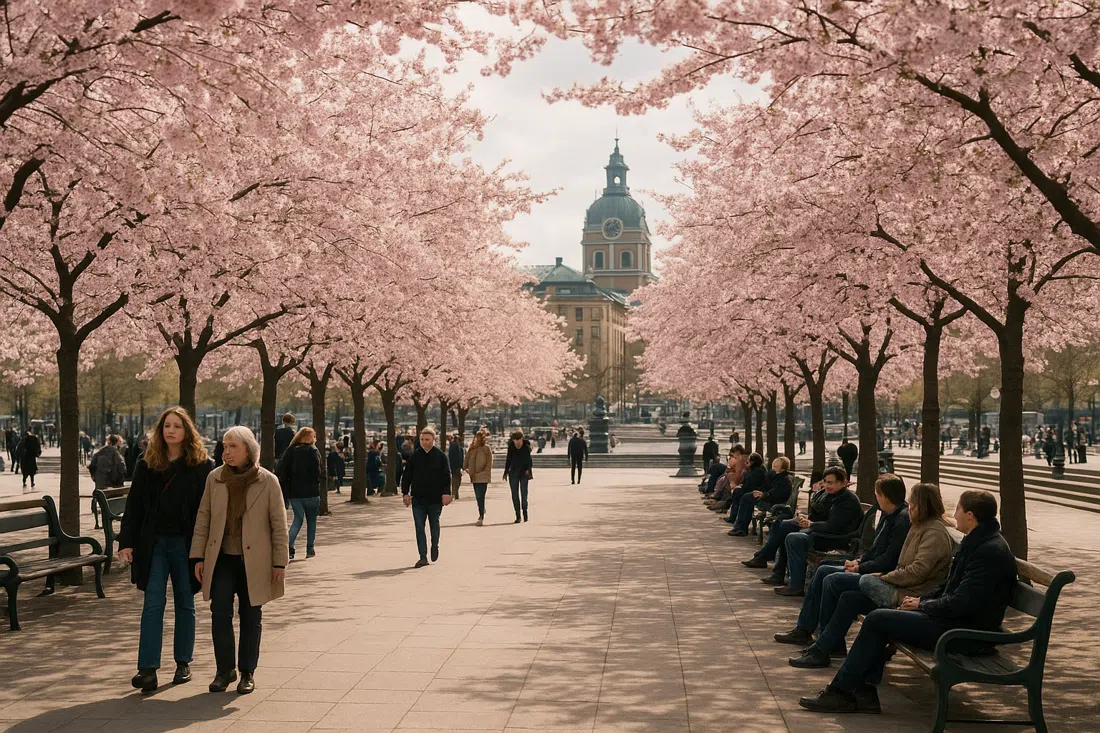
A few minutes away, Kungsträdgården offers the softer counterpoint. The park stretches from Hamngatan toward the water, and in spring its roughly 60 Japanese cherry trees draw crowds to a free blossom festival, usually at peak bloom in mid-to-late April. Winter brings an outdoor ice rink; summer brings food trucks, concerts and a more languid, open-air rhythm. If Sergels Torg is Norrmalm’s hard geometry, Kungsträdgården is its exhale.
Underground, T-Centralen keeps the district’s public life moving. The blue-line platforms, painted by Per Olof Ultvedt with sweeping blue foliage and the silhouettes of the workers who built the station, are among Stockholm’s most photographed metro spaces. There is no special ticket, no ceremony, just the ordinary act of taking a train — and then, suddenly, a station that feels like a gallery. In a neighbourhood built on function, that kind of surprise matters.
From a fish-hall lunch to a ten-course tasting menu
Eating in Norrmalm can mean a quick tray of lunch food or a reservation booked months in advance. The range is part of the district’s personality: this is where office workers, shoppers, travellers and celebratory diners all collide, often within the same block.
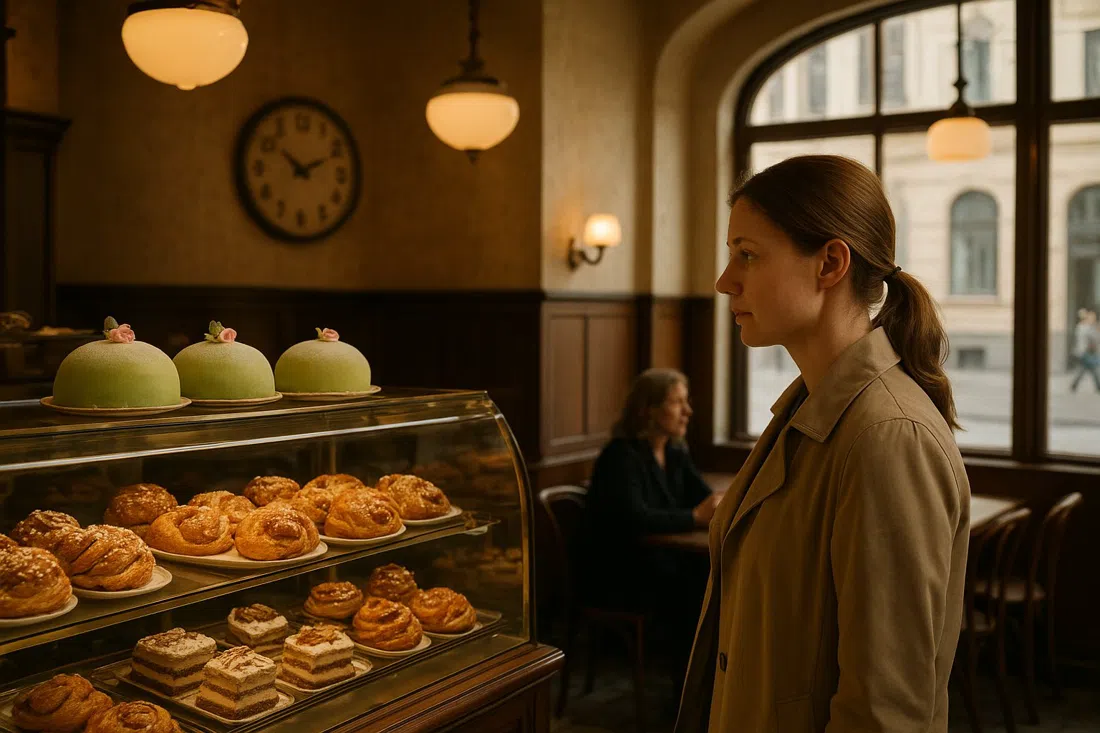
Vete-Katten has been doing the gentler end of the spectrum since 1928. The Kungsgatan konditori is a warren of 1920s-decor rooms with entrances on three streets, and it still feels like a place where time is measured in coffee cups and cake slices. Regulars come for princess cake, cardamom buns and the hazelnut Budapest cake; at lunch, the self-serve counter does exactly what a city-centre café should do, which is feed people properly and efficiently without making a fuss.
For something faster, K25 is all momentum. The eleven-kitchen food court sits under one of the district’s overpasses on Kungsgatan, with sushi, ramen, Korean barbecue, Turkish grill and langos gathered around a central seating bank. It is order-and-buzz lunch territory, built for people on the move and priced for the reality of a workday break. You do not come here to linger; you come because it is efficient, central and close to everything else you need to do.
Then there is Hötorgshallen, sunk beneath Hötorget since the 1950s rebuild and renovated most recently in 2013. The market hall holds 40-plus stalls of fish, cheese, spice and deli counters, and several run lunch tables among the produce. Above ground, the square supplies weekday fruit and flower stalls, and on Sundays it turns into a flea market. The whole arrangement feels like a reminder that Norrmalm has always been as much about commerce as culture — and that the two are not really separate here.
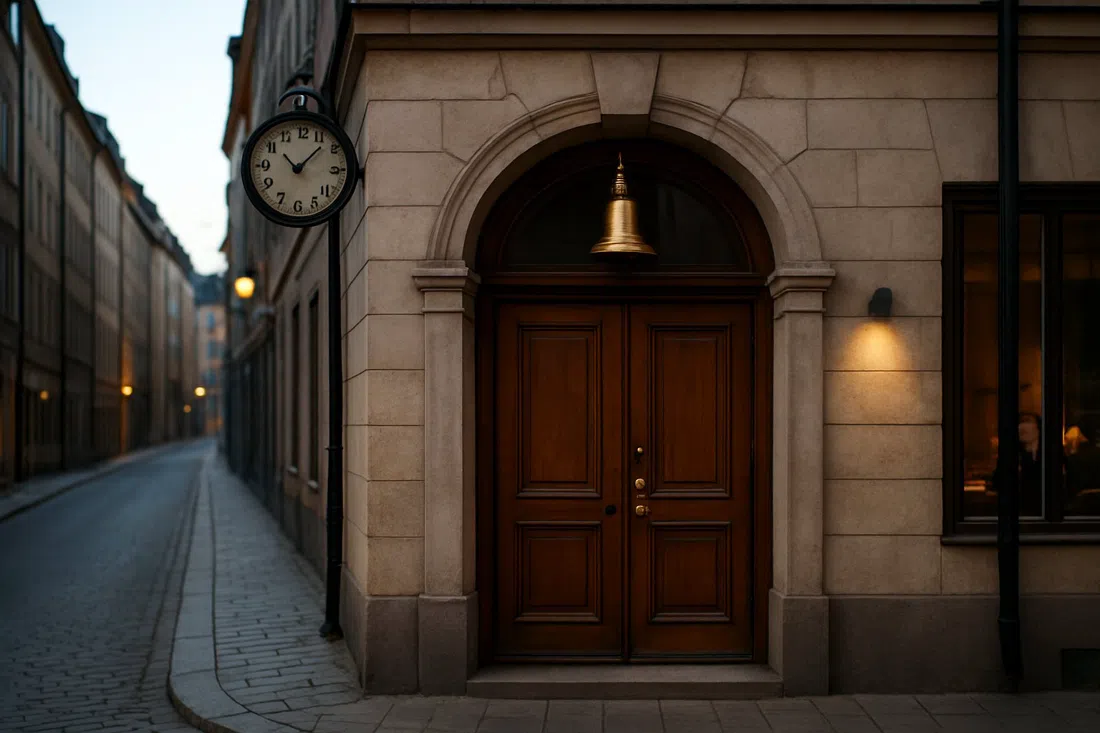
At the far end of the scale sits Frantzén, on Klara Norra Kyrkogata inside a 19th-century townhouse. It is Sweden’s only three-Michelin-star restaurant, and the experience is theatrical from the first moment: guests ring a bell to enter, take an aperitif in a top-floor lounge, then move between rooms for a roughly ten-course tasting menu built around counter-seat theatre in front of the kitchen. There are twenty-three people a night, and the whole thing feels intentionally intimate, almost conspiratorial, as if the city has hidden its most elaborate meal two floors above the everyday street.
Rooftops and a jazz room that's run since 1977
By evening, Norrmalm’s energy changes but does not disappear. It simply rises above the street. The district’s nightlife is stacked onto rooftops and tucked into long-running rooms where the crowd knows what it came for.
TAK, thirteen floors above Brunkebergstorg, is the clearest example of the upward turn. The Nordic-Japanese kitchen sits alongside a rooftop terrace and bar one floor up, and the draw is obvious: sunset cocktails with the City Hall and Södermalm skyline behind the glass. It is the kind of place that makes the city feel legible from above, all water, towers and bridges in one sweep.
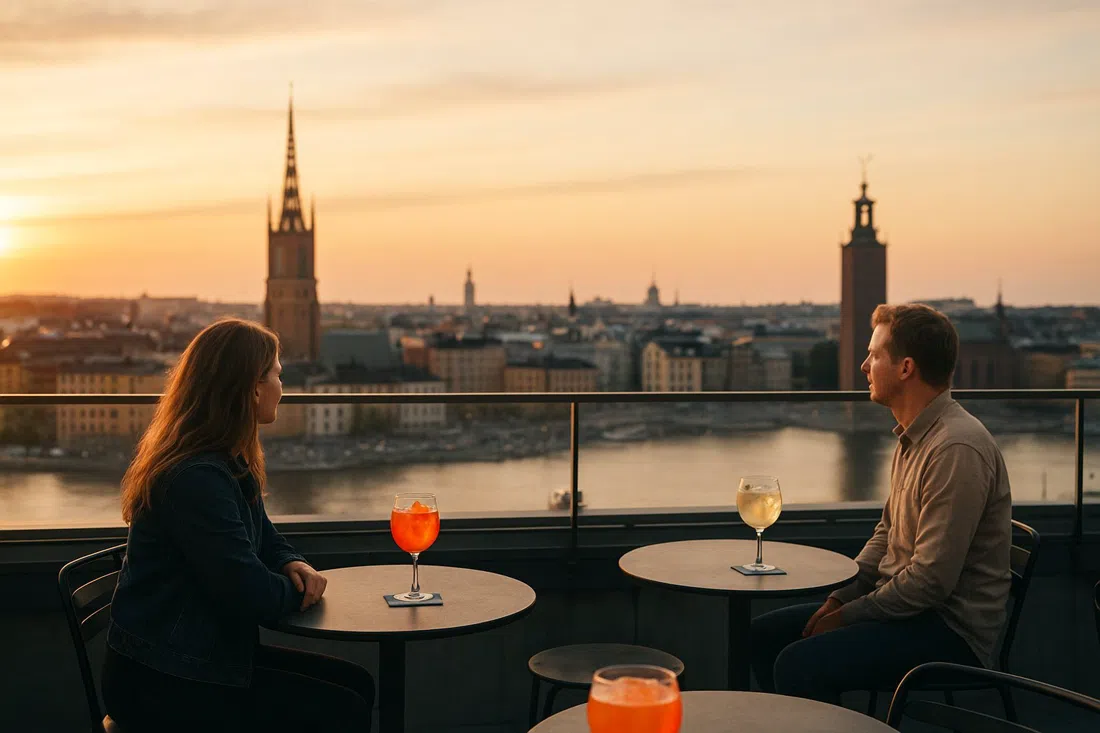
Directly on the same square, SUS — Stockholm Under Stjärnorna — takes the rooftop idea and stretches it across 1,200 square metres. The terrace is split into themed pockets, including Djungeln, a palm-and-sand corner, and Molnet, a cocktail nook; through the warmer months there are DJ nights, rooftop yoga and open-air cinema. It is more playful than TAK, less about the view than the atmosphere, but the effect is the same: Norrmalm likes its evenings elevated.
For something older-school, Fasching on Kungsgatan has been Scandinavia’s biggest jazz promoter since 1977. The room is intimate, the crowd close to the stage, and the late bar runs to 3am on weekends. That longevity matters. In a district often defined by redevelopment and transit, Fasching offers continuity — the sense that some places survive not because they are fashionable, but because they are useful to the city’s cultural bloodstream.
Operabaren, inside the Royal Opera House on Karl XII:s torg, shifts the mood again. This is the preserved late-19th-century option: stained glass, dark wood and a quieter crowd nursing classic cocktails rather than shouting over a DJ. It is not trying to compete with the rooftops. It simply gives Norrmalm a more formal night-time register, one that feels almost ceremonial after the brightness of Brunkebergstorg.
Parks, squares and a metro station that doubles as a gallery
If you want to understand Norrmalm without paying for a ticket, start with the free public spaces. They tell the story better than any single museum could.
Kungsträdgården is the district’s park proper, a long formal green that softens the hard edges of the centre. In spring, around 60 Japanese cherry trees draw crowds to the free blossom festival, usually at peak bloom in mid-to-late April. Winter brings the ice rink; summer layers in food and music events. It is the most photogenic corner of a district not usually accused of prettiness, and it proves that civic Stockholm can still be generous.
Kulturhuset and Sergels Torg sit together as the district’s civic set piece. The square is all hard surfaces and movement; the culture house on its south flank provides the counterweight, with free galleries, a library and performance spaces that invite you to step out of the flow. In a neighbourhood where most people are either arriving, leaving or hurrying through, that invitation matters.
Then there is T-Centralen, the most quietly astonishing free sight in the district. Ride down to the blue-line platforms and you are inside Per Olof Ultvedt’s painted world: blue vine-like forms sweeping across the ceiling, workers’ silhouettes embedded in the station’s cave-cut walls, the whole thing turning a commuter platform into a public artwork. It costs nothing beyond a normal metro ticket, but it changes the way you think about the city’s underground.
Shopping the city’s actual high street
Norrmalm is where Stockholm shops in the broad, practical sense of the word. It is not the district for hidden ateliers or secret design addresses. It is where people come to buy what they need, what they want, and what they can carry home in a bag between errands.
Drottninggatan is the spine. Pedestrianised since the mid-1960s, it runs close to two kilometres from the waterfront up toward Vasastan, and it is lined with a mix of chain stores, Swedish fashion brands and tourist-facing gift shops. The central stretch near Sergels Torg is the busiest and most crowded, which is exactly why it works: it is the city’s high street in the plainest possible sense.
Off Hamngatan, NK — Nordiska Kompaniet — plays the grande dame. Open since 1915 beneath its landmark rotating rooftop clock, the department store spans four floors of designer fashion, homeware and a basement food hall. It still draws around twelve million visitors a year, which is less a retail statistic than a statement of fact about where people end up when they need something reliable and central.
Between those anchors, side streets like Sergelgatan and the galleries around Hötorget handle the more everyday errands: electronics, pharmacies, bookshops. That mix is what makes Norrmalm feel less like a destination mall and more like the city’s working centre. You come here to shop, yes, but also to move through the machinery of Stockholm itself.
Where to stay in Norrmalm
Norrmalm’s hotels cluster around two different moods. Brunkebergstorg is the newer, design-led one: a square rebuilt from a car park into a hotel cluster over the last decade. At Six is the flagship, a 343-room art-forward hotel with its own restaurant and the SUS rooftop bar on top. Hobo takes the same square in a more playful direction, with compact rooms, including windowless sleeper cabins, plus a bar, café and co-working space aimed at a younger, design-conscious crowd.
Over on Norrmalmstorg, the mood is more formal. Nobis Hotel occupies a grand 19th-century building and offers a restaurant, Italian bistro and cocktail bar on site, making it a quieter, more traditionally upscale base a short walk from NK and the water. Around T-Centralen and Central Station, the city’s densest run of mid-range chain hotels serves the practical traveller — the person with an early train or an Arlanda Express connection and no patience for transfers.
Expect to pay a premium across the board. This is the most convenient and most heavily booked patch of Stockholm, and the location shows up in the rates. It also shows up in the noise: anything facing Kungsgatan, Sveavägen or Vasagatan directly will hear the city doing what it does best, which is moving.
Getting around
Norrmalm is Stockholm’s transit centre, not merely a neighbourhood with a station in it. T-Centralen is the interchange for all three metro lines — red, green and blue — and sits above Stockholm Central Station, where the Arlanda Express surfaces roughly 20 minutes after leaving the airport. Regional and long-distance trains, plus most airport coach services, all converge here too. In practical terms, that means the district is built for arrivals and departures as much as for staying put.
Hötorget, Kungsträdgården and Norrmalmstorg metro and bus stops cover the eastern and northern stretches, so almost nowhere in Norrmalm is more than a five-minute walk from a station. The district is flat, compact and easy to cross on foot: Sergels Torg to Kungsträdgården is about ten minutes, and Gamla Stan’s northern edge is reachable in fifteen. Östermalm is 10–15 minutes east, Vasastan about ten minutes north, and Södermalm sits across the bridges in 20–25 minutes.
For most visitors, that is the real appeal. Norrmalm is not the place you come to be charmed by a single street. It is the place that lets you spend a day in Stockholm without ever feeling stranded. The district may not ask to be loved, but it gives you something more useful: access, speed and a front-row seat to the city’s daily rhythm.