The Stockholm issue
Ninety Kilometres of Art: Stockholm's Subway Is the World's Longest Gallery
A station-by-station walking guide to the Stockholm metro — where to start, which caverns reward the detour, and how to see the best of it on a single day ticket.

By Anneke VisserNeighbourhood by neighbourhood through Stockholm
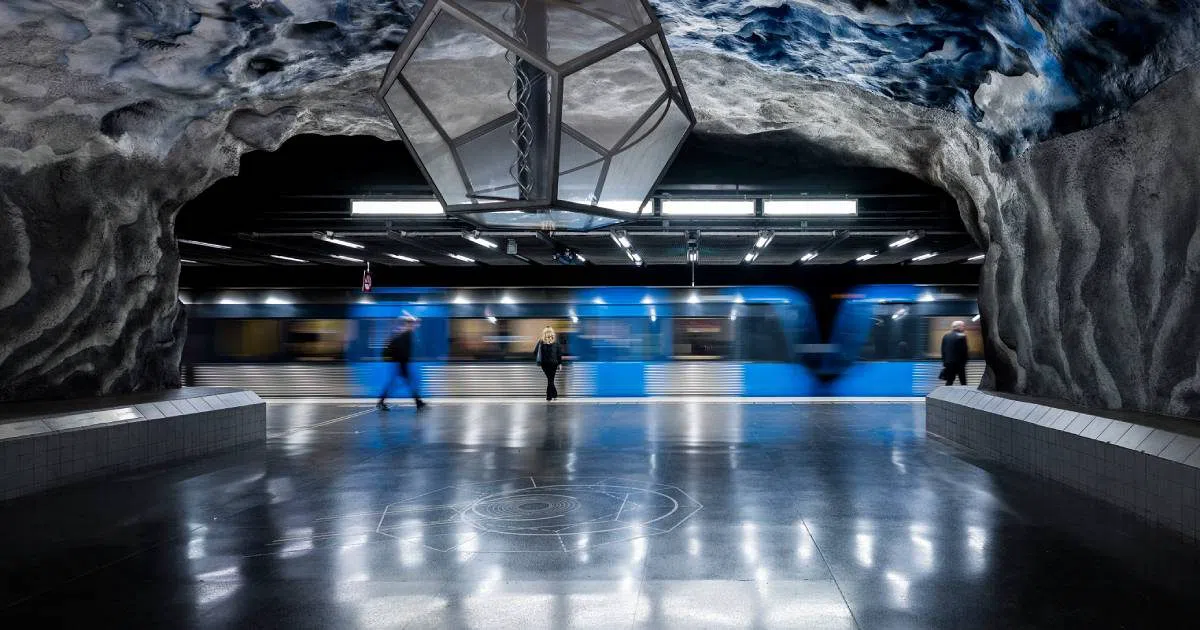
Ride the escalator down at T-Centralen and the ceiling opens into a rough blue cave, painted with climbing vines, and you understand the claim before anyone makes it: this is the longest art exhibition in the world, roughly ninety kilometres of it, and you view the whole thing for the price of a metro ticket. Over ninety of Stockholm's stations were handed to artists rather than to advertisers, and the result is a public gallery you walk through on your way somewhere else. What follows is not a list of everything — it is the route I would give a friend with a day, an appetite for walking, and a single ticket to spend.
Start here: the central hub and the free Art Walk
Begin at T-Centralen (central Norrmalm), because everything on the network passes through it and because its Blue Line platform is the single most photographed spot in the system. Per Olof Ultvedt's blue vine cave — pale leaves and silhouetted workers brushed across the raw rock — was the first of the true "cave" stations, and it still sets the tone: the bedrock is left exposed and sprayed with colour, so you feel underground rather than merely below street level. Stand at the northern end of the platform, away from the escalator crush, and you get the long view down the vault.
If you would rather be walked through it than wander alone, this is also where the free English-language SL Art Walk departs in summer. Between June and August, guides leave from the SL Centre inside T-Centralen and take walk-up groups — no booking, no fee, just turn up and join. It is genuinely group-friendly and a sensible orientation if the network feels daunting; you still need a valid ticket to ride, but the art itself, everywhere, is free to view. The step-free access here is reliable, which matters if you are travelling with a pram or a case.
From T-Centralen, nearly everything I recommend sits on two lines — the Blue and the Red — so you can see a great deal without ever leaving the paid side of the barriers. Keep your ticket handy; some of the best stops are past the natural turn-back point.
Plan your Stockholm trip
Live prices from our booking partners.
Free cancellation on many rooms. We may earn a commission when you book.
The Blue Line's great caverns
The Blue Line is where the metro earns its reputation, and three stations form its blockbuster core. Ride two stops east of T-Centralen to the line's eastern terminus at Kungsträdgården (by the park in the city centre). This is the one I would not skip. Ulrik Samuelson filled it with a subterranean garden — columns, fragments of statuary, a green-and-red palette, water somewhere in the dark — assembled partly from salvaged pieces of demolished Stockholm buildings. It is the richest and most atmospheric station on the network, and it rewards a slow, unhurried walk from one end of the platform to the other. Because it is a terminus, trains sit here a while, so you can let one leave and have the platform briefly to yourself.
Double back through T-Centralen and head west and north toward Solna. At Solna Centrum (in Solna, north-west of the centre), the walls run a hundred kilometres of horizon in fiery red above a dark green forest, painted by Anders Åberg and Karl-Olov Björk in the 1970s as an argument about rural depopulation and the environment. It is the most dramatic single image underground and the easiest to photograph — the colour does the work, and the platform is wide enough that a group can spread out without blocking the flow.
One stop matters for its restraint rather than its noise. At Rådhuset (on Kungsholmen), Sigvard Olsson left the cavern in a raw, Atlas-mountain pink and lit it so it feels like descending into a dig that was never finished — pipes, cladding and rough rock, an archaeological hush. After the fireworks of Solna Centrum it is a deliberate exhale, and the quieter, eerier of the two is the one I find myself thinking about later.
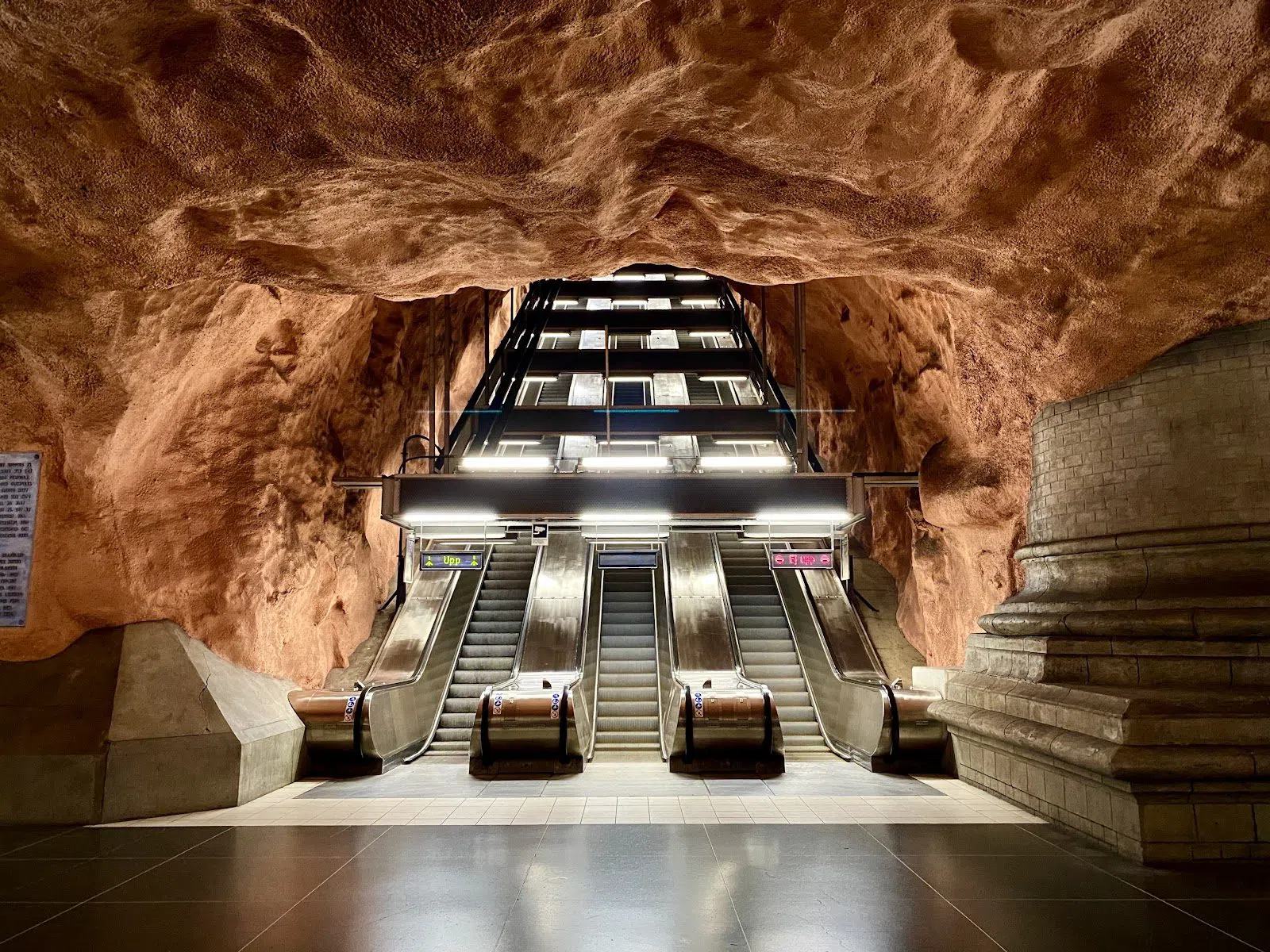
These three handle groups comfortably; there are no doors to negotiate and no bad time to arrive, though platforms thin out pleasantly outside the morning and evening peaks.
Blue Line north: the quieter, stranger stops
Keep going out along the Blue Line and the crowds fall away while the invention does not. These are the stations most day-trippers miss, and they are the reason to hold on to your ticket.
Solna Strand (Solna) is a change of register: Takashi Naraha's blue-and-white cubes float across the ceiling and walls, fragments of sky brought underground, minimalist and sculptural where the painted caverns are busy. It is a calm, almost meditative stop and a good palate-cleanser between the marquee names.
A short ride away, Näckrosen — the name means water lily — nods to the film studios nearby. Lizzie Olsson-Arle's dreamy, watery scheme is underrated precisely because it sits between more famous neighbours; treat it as a bonus rather than a destination and you will be glad you stepped off.
Further out, the art turns from decoration to message. Tensta (a northern suburb) is Helga Henschen's warm, joyful cave, made in and for a neighbourhood built by immigrants — birds, roses, and slogans of solidarity in several languages. It is moving as well as photogenic, and it is worth reading rather than just photographing. Rissne (Sundbyberg) does something similar for the mind: Madeleine Dranger and Rolf Reimers ran a walkable frieze of the history of human civilisation along the platform walls, a timeline you read as you pace. It is quietly impressive and genuinely educational — good if you are travelling with a curious teenager or simply like to learn something on the way.
The most disarming of the northern stops is Hallonbergen (Sundbyberg), where Elis Eriksson and Gösta Wallmark turned real children's drawings into the decor — chalky figures and scrawled scenes across the concrete. It is often called the most child-friendly station in the world, and if you are travelling with kids this is the one to point them toward; it suits families far better than couples chasing atmosphere.
The Red Line: caves, science and the university
Switch to the Red Line back at T-Centralen for a different, more cerebral run of stations, several of them on the eastern, university side of the city.
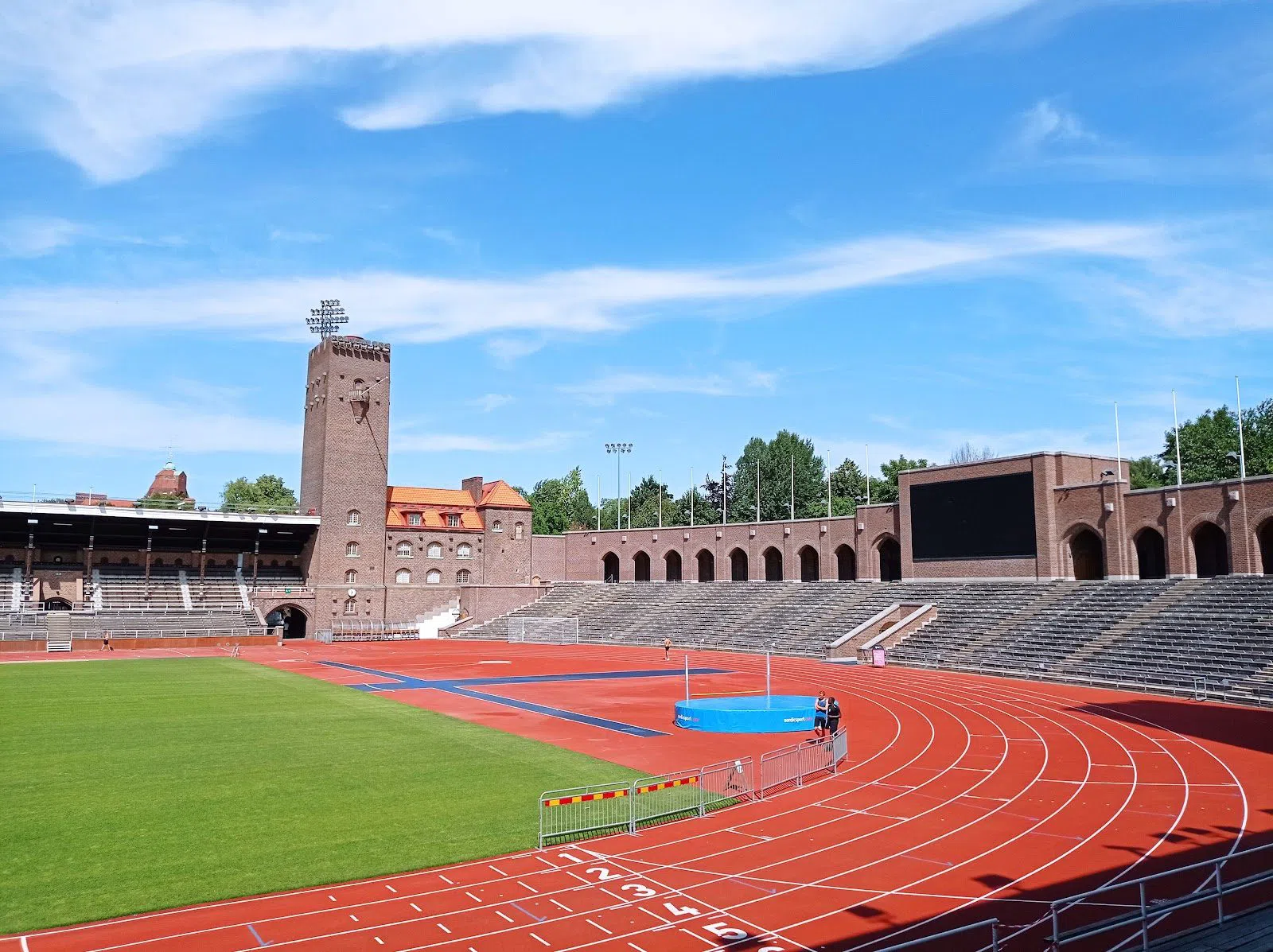
Stadion (Östermalm) is a piece of history: one of the earliest cave stations, opened in 1973, with Enno Hallek and Åke Pallarp's rainbow arcing across the pale-blue rock. It was designed to lift the mood of commuters descending into the dark, and it still works — an instant, uncomplicated crowd-pleaser, and a useful reference point for how the whole cave-station idea began.
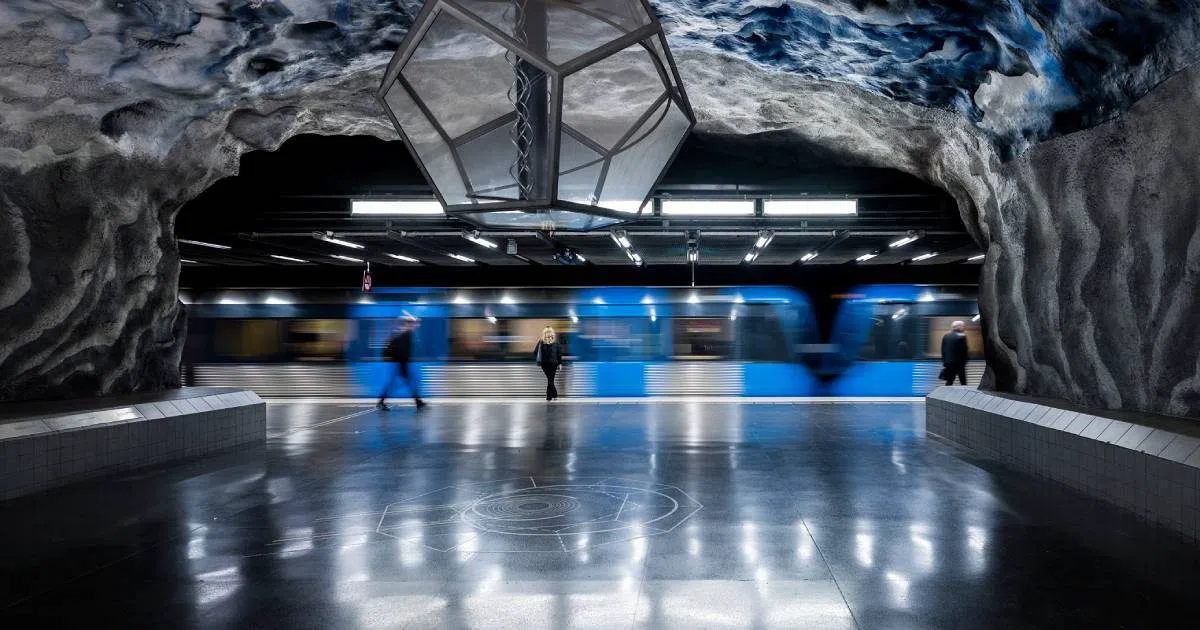
One stop along, Tekniska Högskolan (Östermalm, beside KTH) is the engineers' station. Lennart Mörk's scheme honours science and discovery, and its centrepiece — a large geometric solid, a dodecahedron, hanging in the vault — is a striking, thoughtful highlight next to the technical university it serves. It is a station to stand under and look up.
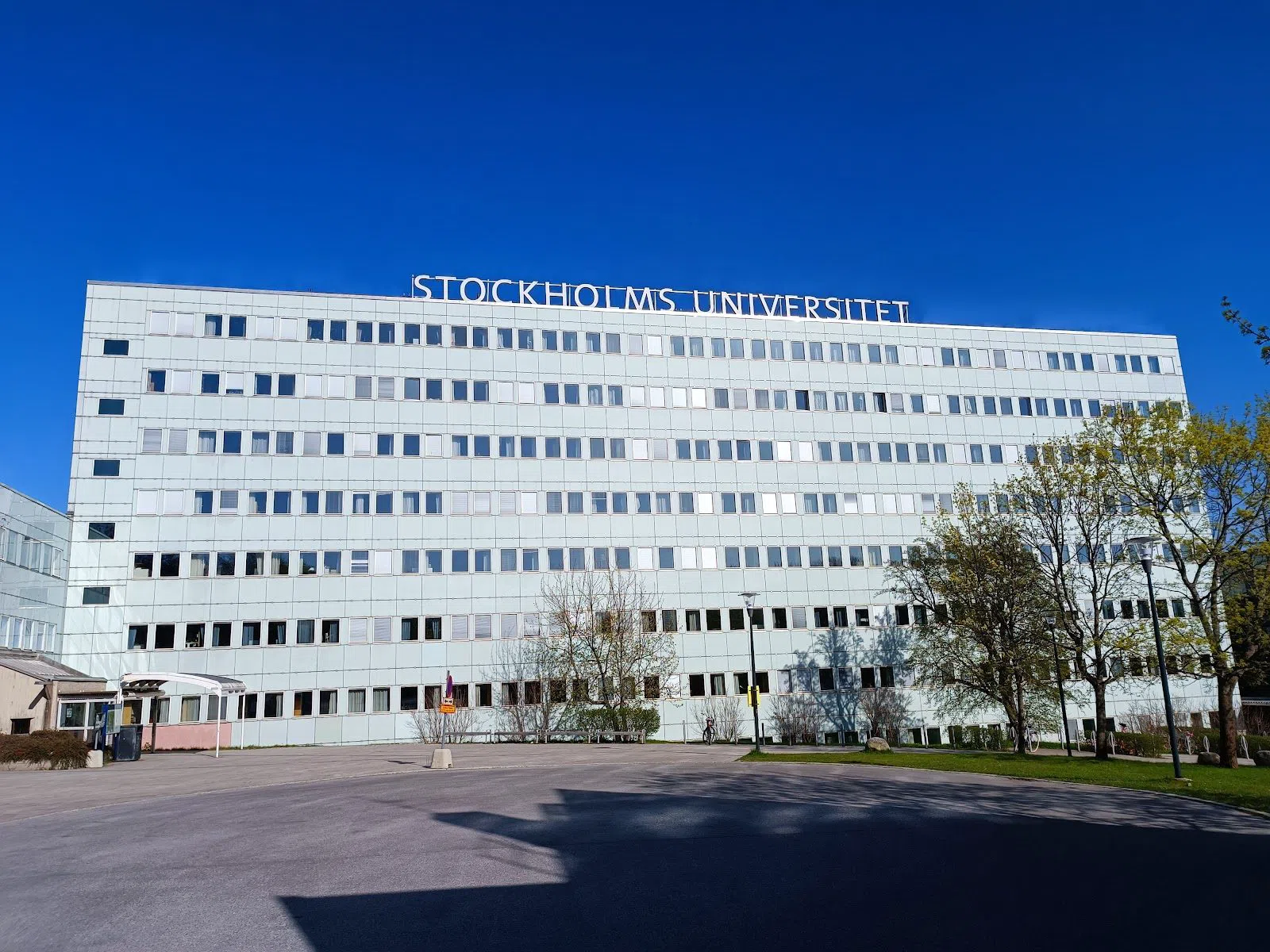
Continue toward the university itself. Universitetet (Frescati, beneath Stockholm University) is Françoise Schein's "thinking" station, its walls tiled in blueprint blue with lines on botany, taxonomy and the Universal Declaration of Human Rights. It rewards a slow read more than a quick photo; give it a few minutes and it becomes the most quietly generous stop on the Red Line.
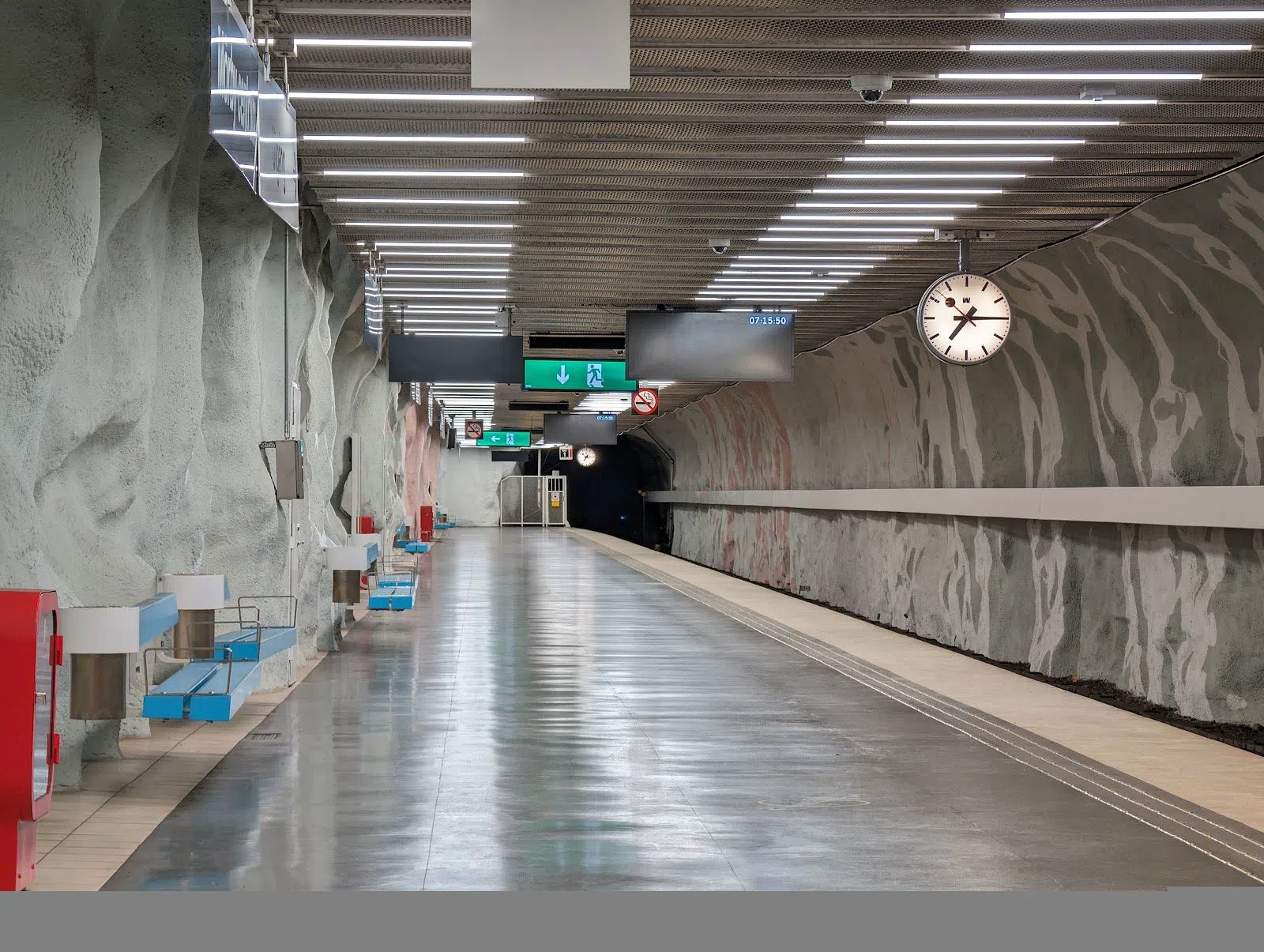
Ride to the northern terminus at Mörby Centrum (Danderyd) for a fitting finale. Karin Ek and Gösta Wessel's walls shift hue as you move along them — a serene colour gradient that changes with your own footsteps. As an end-of-line reward it is calm and modern, and because it is a terminus you can pause, photograph, and ride straight back without changing platforms.
The outlier above ground
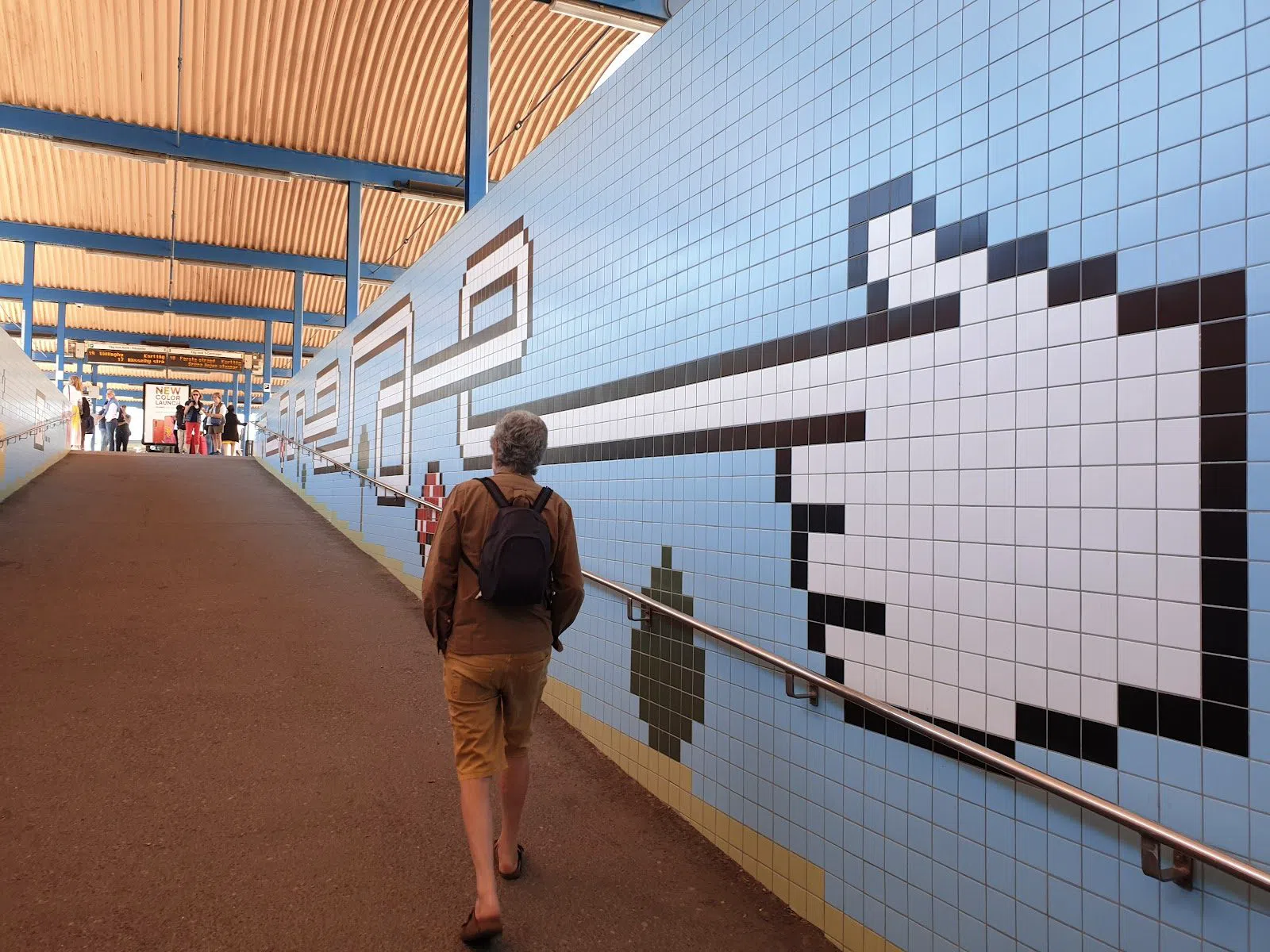
Not all of it is underground, and one station is worth leaving the caves for. Thorildsplan (Kungsholmen) sits above ground on the Green Line, its walls tiled with pixel-art creatures straight out of 1980s video games — Lars Arrhenius's bright, retro-gaming tribute. It is the cheerful odd one out: no cavern, no hush, just daylight and nostalgia. Younger travellers love it, and it makes an easy, low-effort detour if you are crossing Kungsholmen anyway.
How to see it well
A sensible day is a loop, not a sprint. Start at T-Centralen, take the Blue Line east to Kungsträdgården, come back through and run the Blue Line north as far as your patience allows — Solna Centrum and Rådhuset at minimum, Tensta, Rissne and Hallonbergen if you have the appetite — then switch to the Red Line for Stadion, Tekniska Högskolan, Universitetet and, if you want the full arc, out to Mörby Centrum. Fold in Thorildsplan whenever your route crosses the Green Line. Six to eight stations is a comfortable afternoon; trying for all fourteen turns a pleasure into a chore.
Transport and tickets. Every station here is a working public stop covered by any standard metro ticket — no separate admission exists, because the art is simply part of the network. A single journey runs about SEK 42 and is valid for 75 minutes including changes, which is fine if you are hopping between two or three nearby stops; but for a day of getting on and off you want the 24-hour ticket at roughly SEK 175, which pays for itself after four rides and frees you to linger. Buy and store tickets in the SL app, or tap a contactless card at the barriers.
Cash and timing. Stockholm is effectively cashless — you will not need notes, and many barriers and machines no longer take them, so bring a phone or a card. Aim to ride between about 10am and 3pm to dodge the commuter peaks; platforms are calmer and photographs come easier without a train's worth of people in frame. The stations are lit the same all year, so a grey winter afternoon underground looks no different from a bright summer one — this is genuinely weatherproof sightseeing, which is more than most of the city can offer.
Access and groups. T-Centralen is reliably step-free, and most of the cavern stations have lifts, though a few older platforms mean stairs or a walk — check the SL app's accessibility view if that matters to you. Everything on this route handles groups without fuss; there are no doors, no dress codes and no queues, only the ordinary courtesy of not blocking the platform edge. If you would rather be guided, take the free summer Art Walk from T-Centralen and let someone else set the pace.
For somewhere to sleep within easy reach of the Blue and Red lines, start with a Stockholm hotel search; anywhere near a central interchange puts the whole gallery a few stops away. And when you surface for daylight, the rest of the city is waiting in the Stockholm guide. The best part is the honesty of the thing: no ticket booth, no gift shop, no queue — just a train, a platform, and ninety kilometres of rock someone decided to make beautiful.
Before you go
Do I need a special ticket to see the Stockholm metro art?
No. Every art station is an ordinary public stop covered by any standard SL metro ticket — there is no separate admission and the art is free to view. A single ride is about SEK 42; a 24-hour ticket at roughly SEK 175 is better value if you plan to hop on and off, paying for itself after about four rides.
Which Stockholm metro stations have the best art?
Start with T-Centralen's blue vine cave and Kungsträdgården's subterranean garden on the Blue Line, plus Solna Centrum's fiery red mural and Rådhuset's pink cavern. On the Red Line, Stadion's rainbow, Tekniska Högskolan's science theme and the Universitetet tiled station are the highlights. Thorildsplan's retro-gaming tiles are the above-ground outlier.
How many stations can I see in one day?
Six to eight is a comfortable afternoon and leaves time to linger at each. Trying to reach all fourteen notable stations in a single day turns it into a rush. A sensible loop runs the Blue Line east to Kungsträdgården and north through Solna, then switches to the Red Line for the university-side stops.
Is the Stockholm metro art suitable for families and groups?
Yes. Every station is group-friendly with no doors, dress codes or queues. Hallonbergen, decorated with real children's drawings, is especially child-friendly, and Thorildsplan's video-game tiles appeal to younger travellers. Just keep clear of the platform edge and step aside for boarding passengers.
Is there a guided tour of the metro art?
Yes. Between June and August, SL runs a free English-language Art Walk that departs from the SL Centre inside T-Centralen. It takes walk-up groups with no booking required — you only need a valid metro ticket to ride between stations.