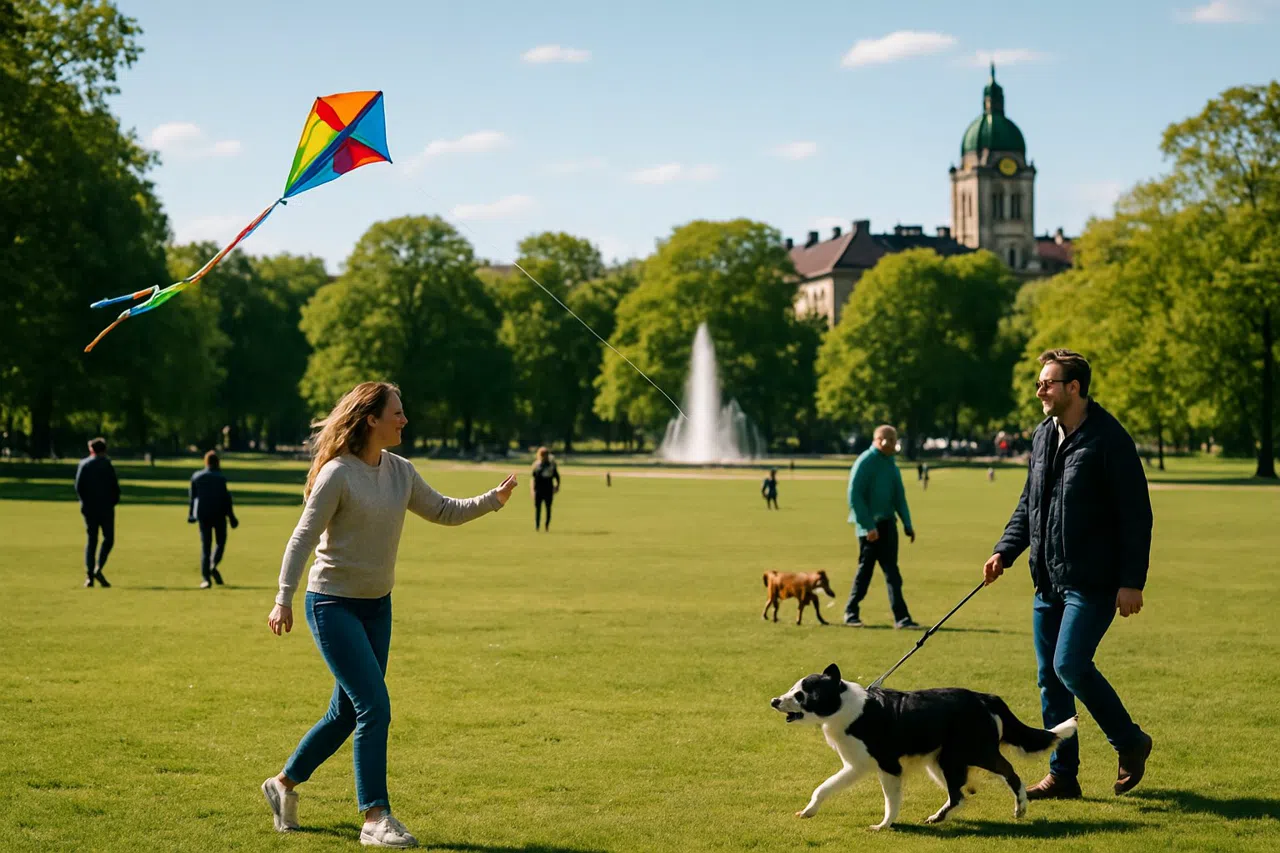
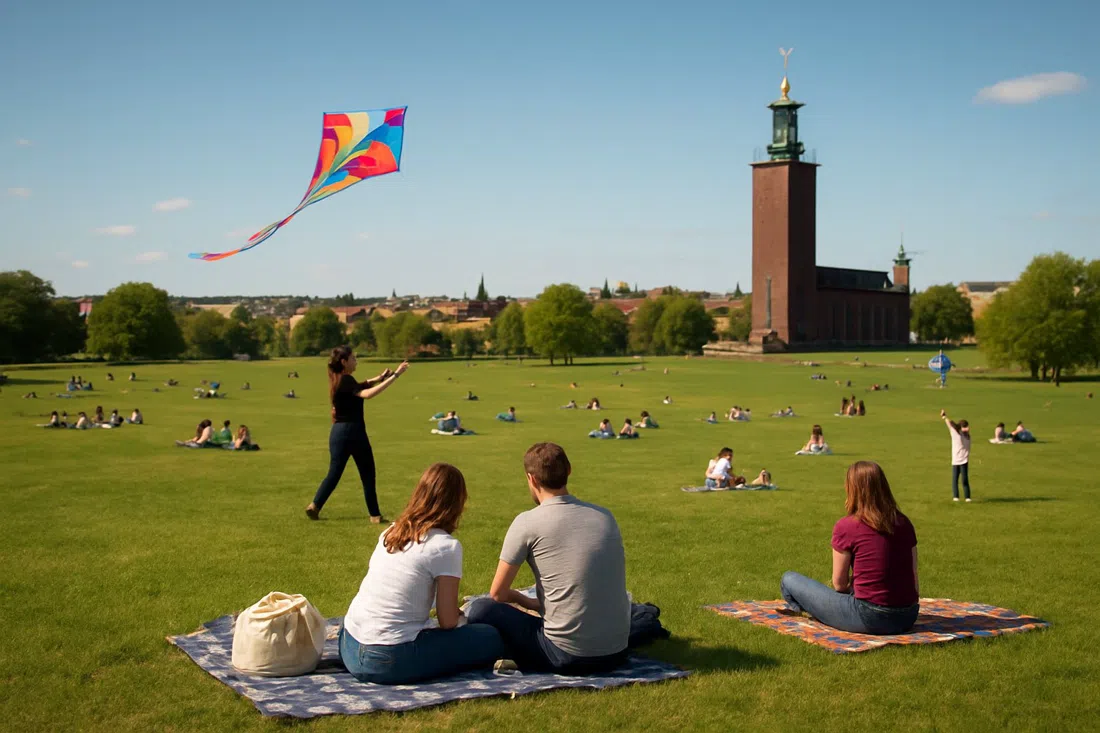
Gärdet begins with a field, not a square, and that tells you almost everything. Ladugårdsgärdet — literally the barn’s field — spreads east of Östermalmstorg in one long, flat sweep of grass that once fed the crown’s cattle, then served the cavalry, and now belongs to runners, kite-fliers, sledgers and anyone who wants a patch of openness without leaving the city behind. On a bright Saturday it can feel almost absurdly spacious for central Stockholm: no souvenir stalls, no camera-chasing crush, no old-town theatre. Just wind, dogs, footballs, picnic blankets and the pale façades of functionalist apartment blocks keeping watch from the edges.
What Gärdet is known for
Gärdet is known, first and most simply, for being open. The field at its centre is Stockholm’s biggest patch of genuinely open green space this close to the core, and people use it as if it were an extension of their own homes. In summer, the grass takes the weight of picnics, sunbathing, circus tents and music events; in winter, the same flatness becomes a place for cross-country skis and kicksledges. That seasonal change is part of the neighbourhood’s charm. Gärdet doesn’t perform for visitors. It absorbs local life.
The second thing you notice is the architecture. The apartment blocks that ring the field were built between 1929 and roughly 1950, and they wear Swedish functionalism with confidence: pale render, flat roofs, ribbon balconies, generous courtyards, the kind of modernism that still looks practical rather than precious. Around 10,000 people live in this coherent residential district, which is why the place feels so settled. It is a look-book for a period, yes, but not a frozen one. Laundry still hangs from balconies. Children still cut across courtyards. The district is lived in, not curated.
Then there is the museum edge, where the grass gives way to Museiparken and the water beyond. Sjöhistoriska museet, Ragnar Östberg’s 1938 Maritime Museum, sits right on Djurgårdsbrunnsviken and is free to enter. Inside are ship interiors, figureheads and navigation instruments; outside, the building’s granite massing has the gravity of something meant to endure. Etnografiska museet is next door, also free, with roughly 220,000 objects covering world cultures. Tekniska museet is a short walk further along and pulls families in with its hands-on science galleries. These are not incidental attractions. They are part of Gärdet’s identity, as much as the field itself.
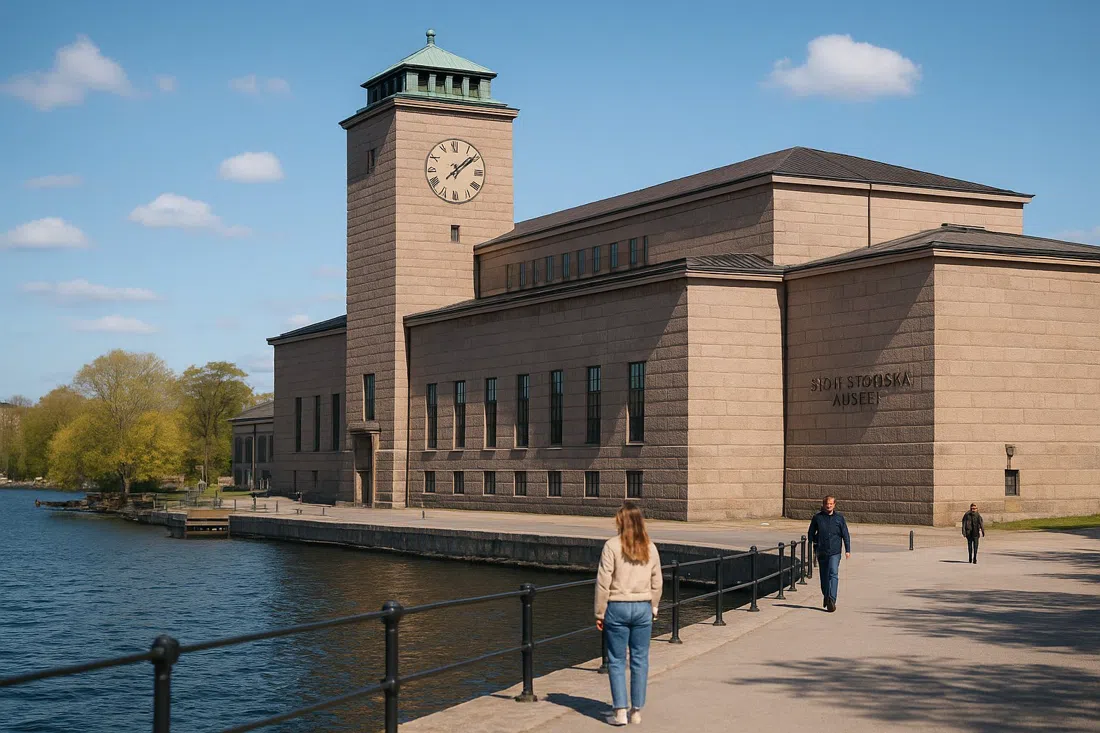
Walk east from the field and the pavement eventually gives way to the bay, and that edge matters. Djurgårdsbrunnsviken separates Gärdet from royal Djurgården, but it also connects the neighbourhood to one of Stockholm’s best everyday running and cycling routes. The path is well used, mostly flat and easy to fall into without thinking too hard about where you’re going. That is very Gärdet: no drama, just a good route and enough space to breathe.
Where to eat and drink in Gärdet
Gärdet’s food scene is not trying to impress the city. It is running a neighbourhood’s honest errands along Valhallavägen and Värtavägen, and that is exactly why it works. You come here for dinner after a museum visit, for a weekday lunch, for a place that feels local rather than algorithmically discovered.
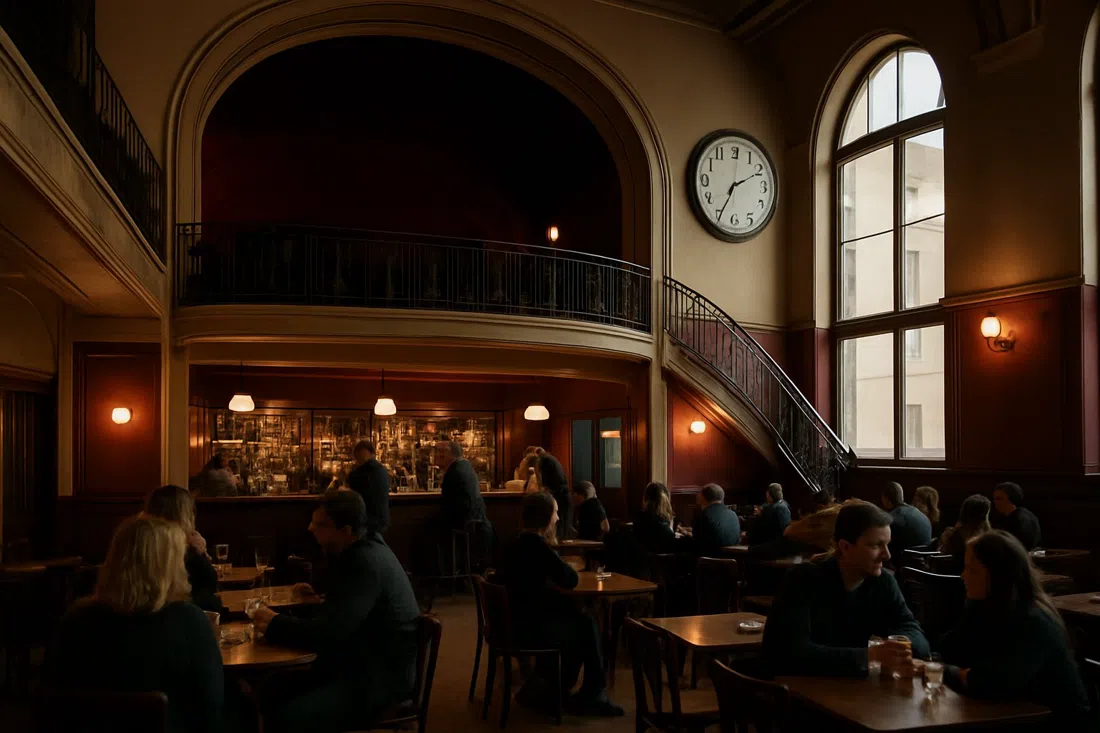
Paraden Kvarterskrog & Barservering, at Valhallavägen 147, is the district’s best-known kitchen and the closest thing Gärdet has to a proper night out. The clue is in the room: it used to be a 1932 cinema, and diners still sit in old cinema chairs on the balcony. Down below, a mini dance floor gives the place a slightly mischievous second life after dinner. The menu leans small plates with a Southern European tilt, and there is a weekday lunch sitting as well. Paraden is not a destination restaurant in the grand sense; it is better than that. It is a useful, atmospheric local room that happens to know how to stretch into evening.
A few doors and a different mood away, Ok ok at Värtavägen 27 is a tiny 22-seat room that opened in 2023 and bills itself as Sweden’s only cider restaurant. The food is Asian-Scandinavian small plates — rice gnocchi, thin-sliced beef, burnt smetana cheesecake have all featured — and the drinks list is built around handpicked ciders and natural wines from small producers. It is the sort of room that rewards a reservation and a little curiosity. Tiny spaces like this can feel precious or forced; Ok ok sounds like it knows exactly how small it is and is happy with that.
Diwan, at Valhallavägen 153, has been part of this stretch for years, and it earns that longevity. Persian and North Indian cooking share the menu, with grilled lamb koobideh and saffron ice cream among the signatures, and the room itself is dressed with kilims and low sofas. That matters. In a neighbourhood defined by practical modernism, a restaurant can either fight the surroundings or soften them. Diwan does the latter.
Högkvarteret, further along at Valhallavägen 188, is the straightforward answer. It is a Swedish kitchen run by two career restaurateurs who lean on regulars rather than turnover, and the menu stays rooted in the familiar: raw herring with roe, fish and chips, minute steak with béarnaise. It is the sort of place that makes a residential district feel complete, because not every meal needs a concept.
For something lighter, Stockholms Glass- & Pastahus at Valhallavägen 155 has been doing pasta, pizza and its own ice cream since the 1980s. It is as close as Gärdet gets to a casual, kid-friendly stop, which is to say: very useful, not remotely flashy, and all the better for it.
Nightlife in Gärdet
Be honest about Gärdet and nightlife, and the place becomes easier to love. This is a residential district, and it goes quiet early. There is no bar strip here, no late-running crawl of places competing for attention. That is not a failure of imagination; it is the point.
Paraden is the one venue with a proper bar setup, a wine and cocktail list and that little dance floor, and on weekend evenings it can feel like the whole district’s social valve. But even there the rhythm is dinner into drinks, not drinks into dawn. If you are looking for an actual night out, the move is to do what locals do: head to Stureplan, Östermalm or on to Norrmalm and Södermalm. Östermalmstorg is only one stop from Karlaplan on the red line, so the transfer is easy enough. Gärdet gives you the quiet before and after, not the main event.
Things to do in Gärdet
The obvious thing to do is the thing people already do here: go to the field. Ladugårdsgärdet is public grassland, with no formal entrance and no ticket, and that openness is exactly why it works so well. You can wander in from almost anywhere and find a version of the neighbourhood in motion. On warm weekends, the field fills with kite-fliers and picnickers. On most evenings there are football games. When snow settles, cross-country skis and kicksledges take over. It is one of the rare central-city landscapes that still feels like common ground.
Past the field, Museiparken makes a tidy, rewarding circuit. Sjöhistoriska museet is the anchor, with its free admission and its maritime interiors and navigation history. Etnografiska museet sits next door with its vast collection of world cultures. Tekniska museet, a little further along, adds hands-on science and technology galleries, plus its own restaurant and café in the Trähallen wooden hall, which is exactly the sort of practical detail that makes a museum day easier to stretch. Together, the three museums create a cultural cluster that feels woven into the neighbourhood rather than imposed on it.
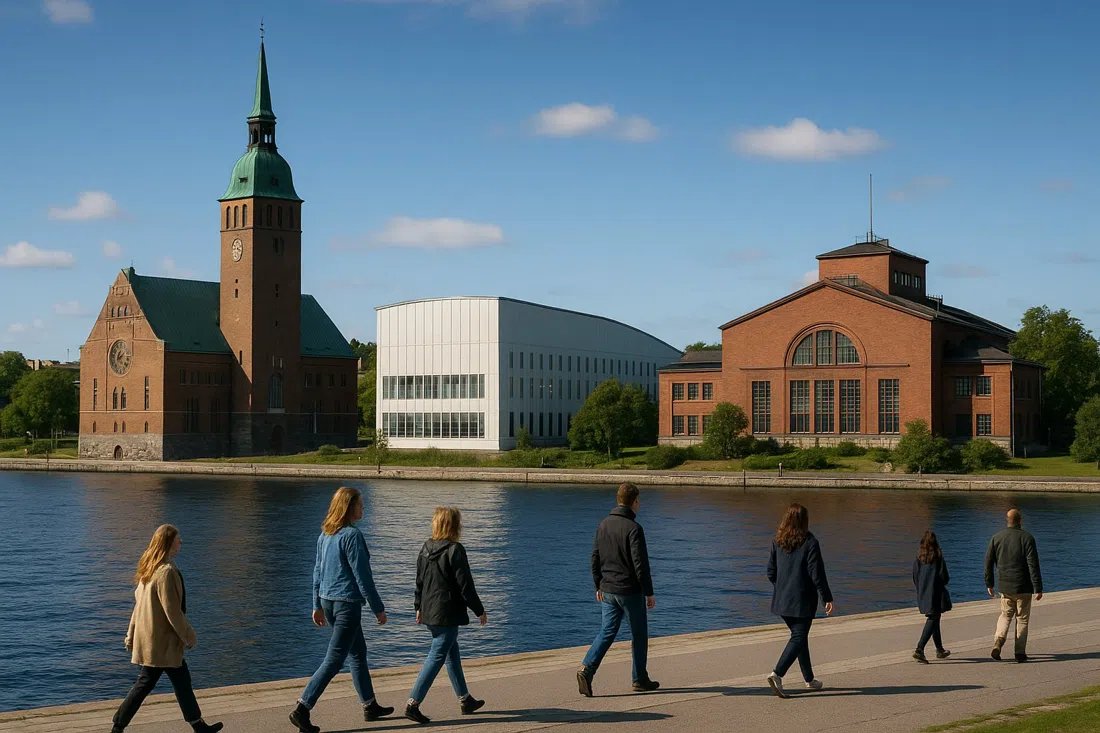
If you keep walking past the museums, the path along Djurgårdsbrunnsviken becomes one of Gärdet’s best everyday pleasures. It is a genuinely good running and cycling route: well maintained, mostly flat, and easy to extend into Djurgården if you want to keep going toward parkland and the Nordic and Vasa museums. This is the kind of route locals use without making a fuss about it. It is scenic, yes, but in an unforced way. Water on one side, trees and museum roofs on the other, and enough distance from traffic to let your pace settle.
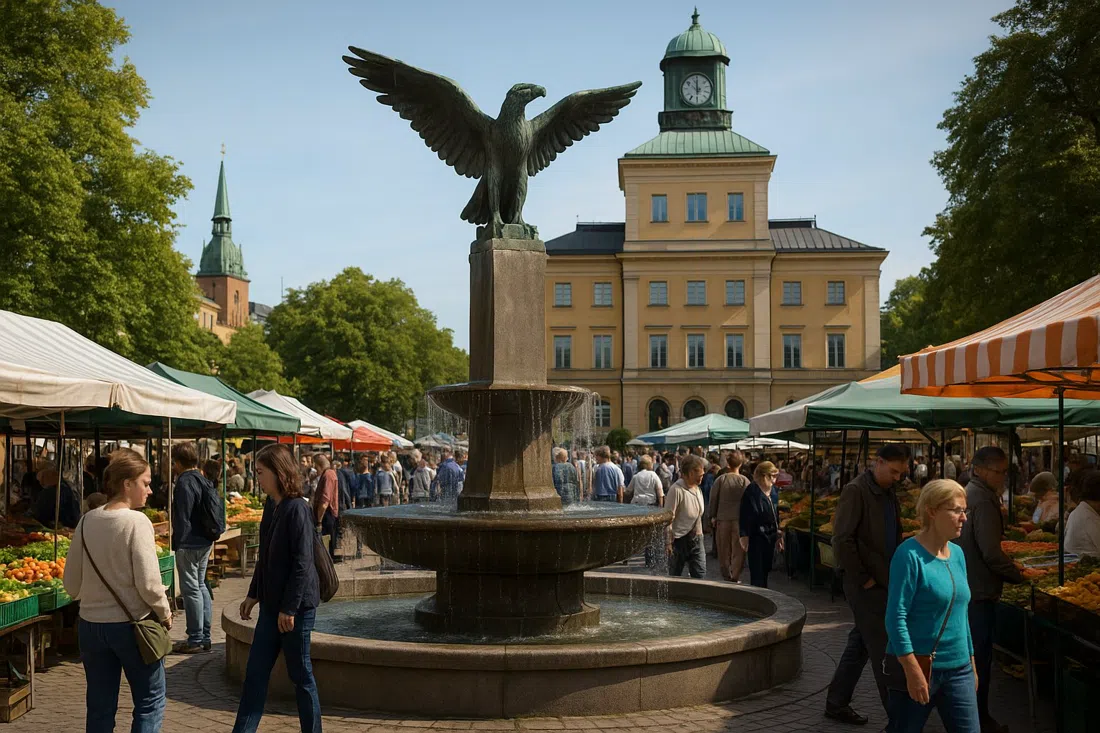
At Karlaplan, the district’s social centre, the mood changes again. The square is star-shaped, with a central fountain and Carl Milles’ bronze eagle, the Flygarmonumentet, standing over the water. From spring through autumn, a Saturday antiques and vintage market forms around it, which gives the place a little extra orbit on weekends. Karlaplan is not a grand civic stage so much as a useful centre of gravity — a place to meet, cross, shop and continue.
Shopping in Gärdet
There is no real shopping district in Gärdet, and that is one of the reasons the area feels so residential. Along Valhallavägen and Värtavägen you get the everyday infrastructure of city life — pharmacies, dry cleaners, the sort of local shops people actually use — not a parade of boutiques designed to pull in visitors.
The one proper option is Fältöversten at Karlaplan, a roughly 60-shop mall that has been trading since 1973. It has clothing chains, a grocery store, a bookshop and a Systembolaget among its tenants, and it is open daily. More importantly, it feels like a local convenience rather than a destination. You go there to get things done. That plain usefulness is, in Gärdet, almost a form of luxury.
Where to stay in Gärdet
Gärdet is overwhelmingly residential, so the accommodation story is necessarily modest. The district’s standing hotel option is Best Western Hotel Karlaplan, two minutes’ walk from Karlaplan metro station and a short stroll from the field and the museum cluster. It is a straightforward business hotel rather than a design statement, but its location makes sense: close enough to the neighbourhood’s main edges, and handy for a quick hop into central Östermalm.
Beyond that, the most natural way to stay here is in one of the functionalist apartment blocks as a short-let. That suits longer visits, families and anyone who values space and quiet over being able to stumble home from a bar. The trade-off is clear and worth accepting. You gain wide streets, green views and a real residential rhythm. You give up the fantasy of walking to Gamla Stan or Stureplan in ten minutes. For many travellers, that is a fair exchange.
Getting around from Gärdet
Gärdet is easy to move through because it was built with room to move. The district is flat, walkable and unusually good for cycling. You can cross the field, follow the bay path, or work your way along the residential streets without feeling boxed in. The red line metro station at Gärdet sits on the T13 line, and Karlaplan is one stop south. From either station it is three stops to T-Centralen via Östermalmstorg, which puts the rest of Stockholm within easy reach without making Gärdet feel like a transit zone.
The district also works well on foot in a broader sense. It is roughly 20 to 25 minutes from Karlaplan into central Östermalm and Stureplan, and buses run along Valhallavägen and Värtavägen. For Arlanda, the route is simple enough: metro to T-Centralen, then the Arlanda Express. Gärdet does not need special transport tricks. It is connected in the standard Stockholm way, which is to say efficiently, and without ceremony.
What lingers after a day here is not a checklist but a feeling of proportion. Gärdet gives you open grassland, free museums, functionalist calm and a neighbourhood life that still seems to belong to the people who live in it. It is quiet in a way that feels deliberate. It is green in a way that feels earned. And it is one of the few central Stockholm districts where the most memorable thing may simply be the space between the buildings.