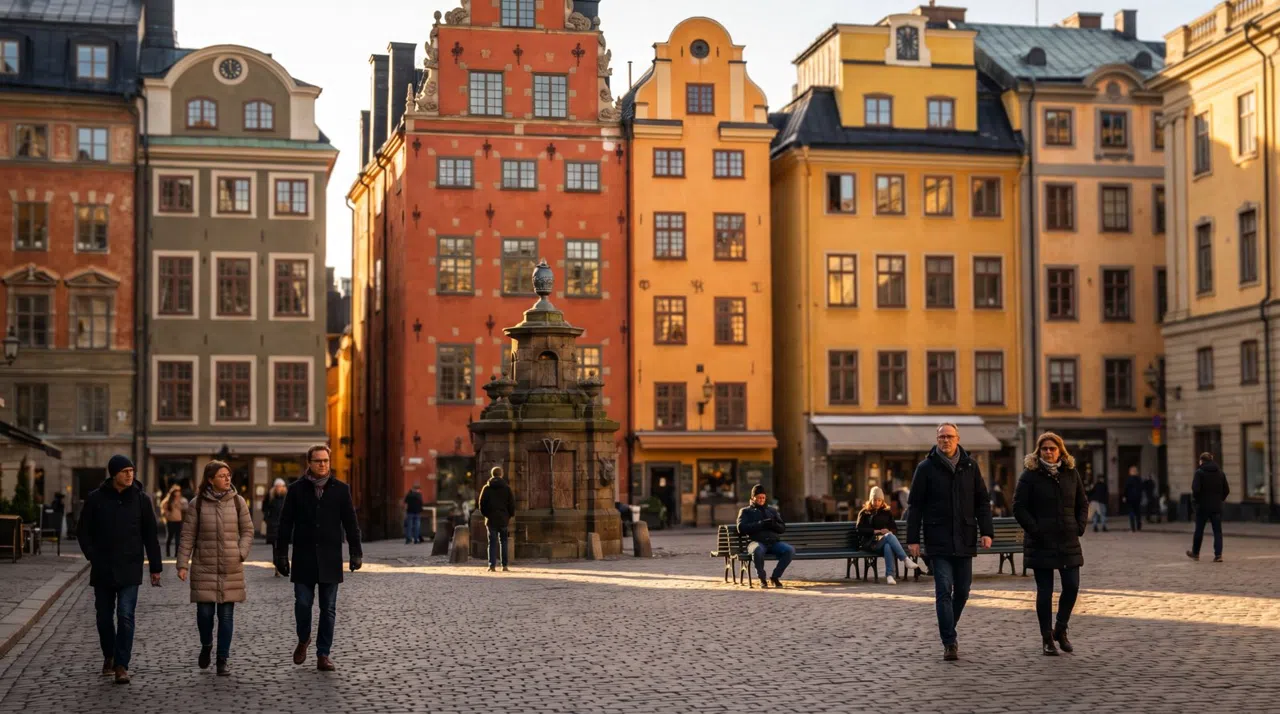
Every color-block townhouse ringing Stortorget carries a stain of memory: this is the square where 82 nobles were beheaded in 1520, and where Stockholm’s prettiest postcard has the city’s darkest footnote. By late morning in July, a cruise ship can dump 5,000 extra people onto this half-square-mile island, and the lanes that are barely a shoulder-width wide begin to clog between 11am and 2pm. Come before 9am or after 8pm, though, and Gamla Stan changes character completely — the same cobbles, the same ochre facades, but with room to hear your own footsteps.
Stockholm's medieval core, built on trade and myth
Gamla Stan is not a themed district pretending at oldness. It is where Stockholm began: a fortified trading settlement founded around 1252 on the island that guards the passage between Lake Mälaren and the Baltic. The street plan still behaves like a medieval street plan should — crooked, narrow, made for foot traffic and handcarts, not cars — and the inner core is now car-free, which is why the place feels so immediate underfoot. You don’t so much drive through Gamla Stan as submit to it, one lane at a time.
The island is technically a cluster of three, with Riddarholmen and Helgeandsholmen tucked alongside, but everything important sits within a ten-minute walk. The main arteries, Västerlånggatan and Stora Nygatan, run the length of the old town like two parallel seams, lined with amber jewellery, cinnamon buns and moose-antler souvenirs. Then, as if someone has turned a volume knob down, the side alleys peel off into near-silence within thirty steps. Prästgatan, one street back from Västerlånggatan, is the clearest example: laundry on balconies, cats on windowsills, and a rare-book dealer that has been trading for decades.
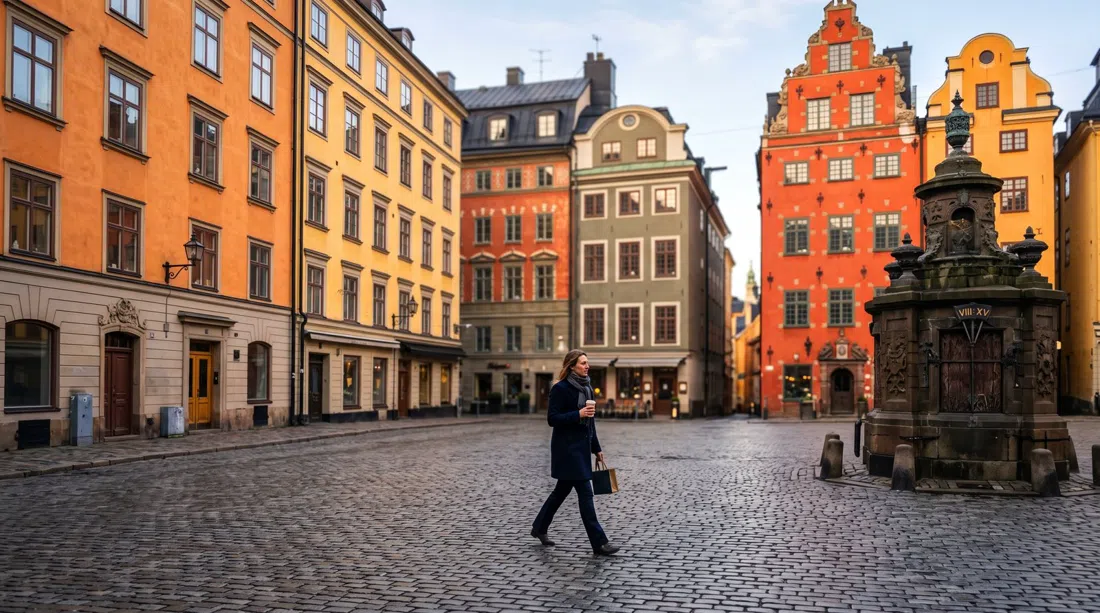
Stortorget is the place to start because it contains the old and the brutal in one glance. It was the city’s marketplace, and in 1520 it became the site of the Stockholm Bloodbath, when the Danish king had roughly 80 Swedish nobles and clergy executed in a single sitting. The ochre, saffron and rust-red houses around the square date from the rebuilding that followed. Stand there long enough and the square stops reading like a postcard and starts reading like a ledger of power, commerce and punishment.
Just a short walk away, the Royal Palace still acts like a working seat of state rather than a sealed monument. It is one of the largest palaces in Europe, with around 600 rooms, and its presence is felt all over the old town — not just in the forecourt, but in the way the streets seem to orbit duty. Next door, Storkyrkan cathedral was consecrated in 1306 and remains the oldest building in Stockholm. It has hosted coronations and weddings, but it also remains an active parish church, which matters: this is not museum ambience, but living ritual embedded in stone.
Mårten Trotzigs Gränd is the alley everyone photographs, and for good reason. At its narrowest it is around 90cm wide, a stone crease in the city, named for a 16th-century German-Swedish copper trader. Nearby, Köpmangatan is generally cited as Stockholm’s oldest street. In Gamla Stan, history is not confined to a few headline buildings; it is the floorplan.
Cellar dining that outlasts the tour groups
The best meals here are usually found one or two streets back from the souvenir gauntlet, where the old rooms are deeper, the light is lower, and the menus are less eager to translate themselves for bus groups. This is cellar country: vaulted ceilings, candlelight, old brick, and the sense that dinner should take its time.
Den Gyldene Freden, on Österlånggatan, has operated from the same address since 1722 and is now run by the Swedish Academy. That lineage is part of the appeal, but so is the plain fact that the room still feels like a room, not a relic. Order the classic herring plate or reindeer and you are eating in spaces that have barely shifted shape in three centuries.
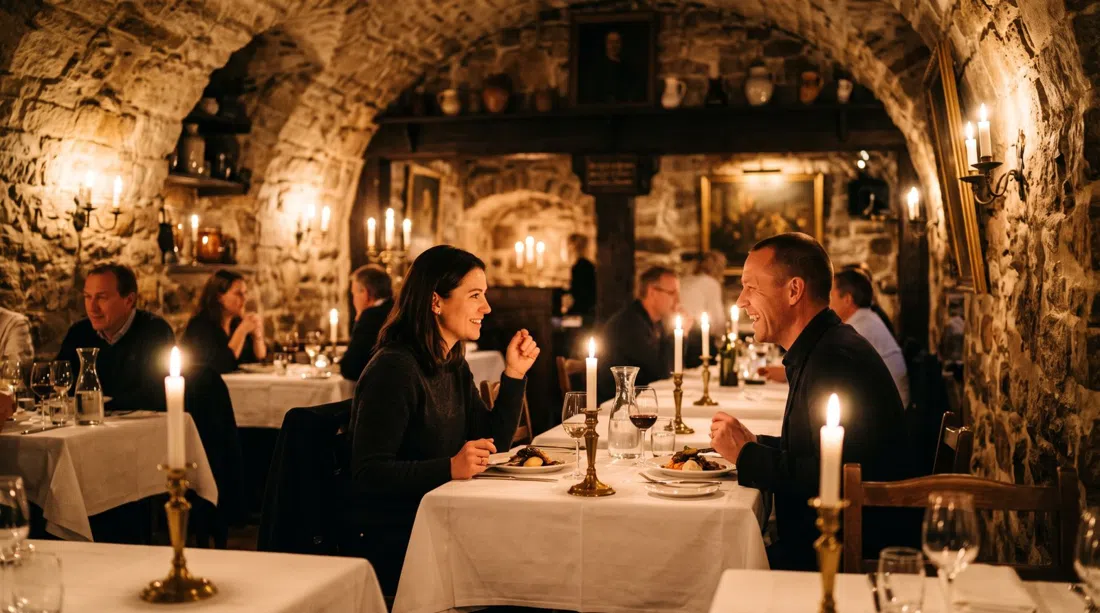
Fem Små Hus, built into five conjoined 17th-century houses at Nygränd 10, is often cited as the oldest continuously operating restaurant in Sweden. Its vaulted cellar rooms and tablecloths suit a slower, French-inflected Swedish menu, and it is the sort of place that rewards booking ahead for dinner rather than improvising. The atmosphere is intimate in the old sense of the word: close, hushed, and just formal enough to make a night feel like an occasion.
Kryp In, on quiet Prästgatan, is smaller and more personal still — a candlelit room with maybe a dozen tables, known for reindeer, cod and Swedish meatballs with lingonberry. It fills fast enough that a reservation is close to essential, which feels right for a restaurant that benefits from the same quiet that makes the street itself so appealing. This is the meal to plan around if you want the old town without its daytime volume.
Aifur, on Västerlånggatan, goes in the opposite direction: vaulted-cellar Viking theatrics, mead, spit-roast meat and live music. It now runs Friday and Saturday only, so the trick is not to drift in expecting a casual weeknight dinner. It is a performance as much as a meal, and it wears that role openly.
For something plainer and cheaper, Stockholms Gästabud does walk-in Swedish home cooking without the cellar drama. That distinction matters in Gamla Stan, where the main lanes can push tourist rates hard and the temptation is to mistake visibility for value. The best tables are often the ones that look as though they have no need to advertise.
Cellar pubs, not clubs
Gamla Stan is not where you come to chase a late-night crescendo. It goes quiet earlier than Södermalm or Stureplan because it is a residential, government-adjacent island, and the after-dark scene leans toward cellar pubs rather than clubs. That is a limitation only if you want one. If you want atmosphere, it is a strength.
Wirströms Pub, on Stora Nygatan, is the long-standing anchor. It is an Irish-style pub with vaulted below-ground rooms, free live music most nights of the week — Irish folk, blues, soul — plus a big whisky and beer list and quiz nights that draw a mixed local-and-visitor crowd. It stays open past 1am on weekends, which is late by Gamla Stan standards and enough to make it the natural landing point for a final drink.
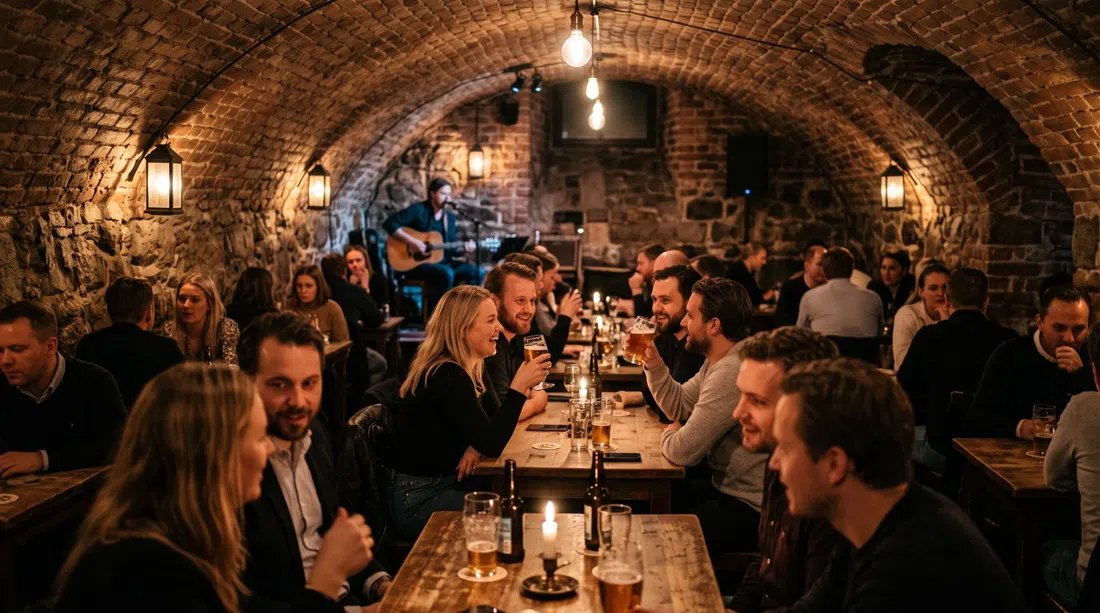
Sjätte Tunnan leans harder into the medieval setting, with stone walls, cask-style tables and low light. It is better for a quieter pint or two than for a raucous night out, and that restraint suits the island. Most other bars on the main lanes wind down by midnight, and anyone wanting a proper club scene generally crosses the bridges into Norrmalm or Södermalm instead.
What Gamla Stan does well after dark is simpler: a nightcap in a 17th-century vault, cobbles underfoot, and far fewer people than at 1pm. The crowds that make the island feel compressed by day are mostly gone, and what remains is a neighbourhood that remembers it is also lived in.
The Palace, the cathedral, and the narrowest alley in town
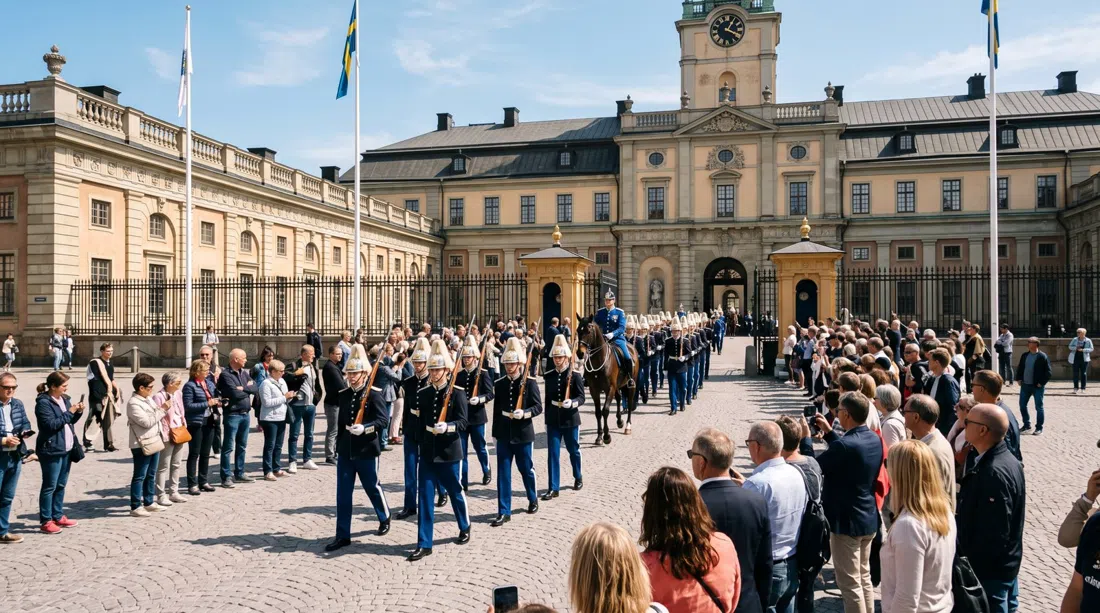
The obvious sightseeing circuit is compact enough to cover in a focused half-day, but it is dense enough that each stop earns its place. The Royal Palace is the headline. With more than 600 rooms, the Royal Armoury’s collection of arms and royal regalia, and a free daily Changing of the Guard at 12:15 on weekdays and 13:15 on weekends, it gathers a crowd on the forecourt without ever losing its working-government feel.
Storkyrkan sits next door and deepens the mood. Stockholm’s oldest building, consecrated in 1306, it is worth the modest entry fee for the 15th-century wooden sculpture of Saint George and the Dragon as much as for the sense of continuity. The cathedral is active, not frozen, and that matters in a district that can otherwise feel over-curated by the pressure of visitors.
Across Stortorget, the Nobel Prize Museum occupies the old Stock Exchange building and follows the history and personalities behind the prizes. The attached café serves the Nobel Ice Cream once served at the Nobel Banquet, and entry is free on Tuesday evenings. It is one of the few places in Gamla Stan where the city’s global modern identity and its old-town architecture sit comfortably together.
But the real pleasure here is the walking between the named sights. Down Mårten Trotzigs Gränd, along Köpmangatan, back to Stortorget, then across to Riddarholmen, where the pace drops again. Riddarholmen Church, the royal burial church, sits close to the water, and from the western quay you get arguably the best skyline view of Stockholm’s water and rooftops, with a fraction of Gamla Stan’s foot traffic. If the old town feels crowded, this is where it exhales.
Västerlånggatan's souvenir gauntlet, and what's worth a detour
Västerlånggatan is the island’s main pedestrian spine, and it behaves exactly like that description sounds: a long, busy corridor of souvenir shops, amber jewellery and Dala-horse stock. It is worth walking, but not lingering unless you are in the market for magnets, mittens or a quick browse under pressure. The street can feel like one extended retail funnel, especially when the cruise-ship crowds are in motion.
Still, there are a few shops worth singling out. Indus The Gift Shop at Västerlånggatan 34 has been operating since 2006 and mixes proper Swedish design pieces in among the expected trinkets. Sól Handkraft at Västerlånggatan 24 sells handmade Swedish crafts, including antique and new Dala horses and lined woollen mittens. Kerstin Adolphson, a family business trading since 1973 with several addresses along Västerlånggatan, specialises in traditional Swedish knitwear, wool sweaters and wooden clogs rather than one-off souvenirs.
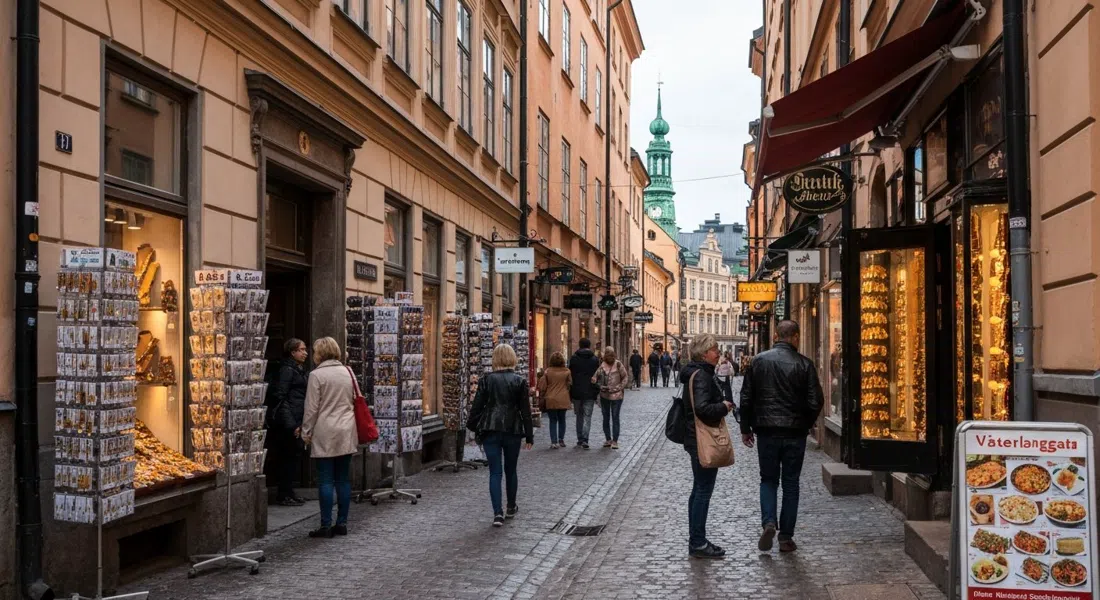
If the main drag starts to feel like a single long gift shop, the smaller cross-streets and Stora Nygatan reward detours. There you’ll find antique dealers, a rare-book shop or two, and small galleries, all of which feel more in step with the island’s older grain. Christmas is a genuine speciality here too: several shops on and around Västerlånggatan sell hand-carved and painted Christmas decorations year-round, which gives the street a seasonal afterlife even in midsummer.
Where to stay in Gamla Stan
Staying in Gamla Stan means being able to walk to the Royal Palace, Stortorget and most major sights in under ten minutes. That convenience comes with a trade-off: small rooms, cobblestone noise and a premium that reflects the location more than the square footage. It is a practical base for first-timers and couples, and a romantic one if you like old walls and candlelit-cellar dinners, but it is not the place to hunt for space.
Lady Hamilton Hotel, just off the palace forecourt, is the classic romantic choice. It leans into Swedish-peasant-style antiques, has a small sauna and cold-plunge pool guests can book free of charge, and serves an organic, homemade breakfast. Hotel Sven Vintappare, in a 17th-century building nearby, is smaller and quieter, with Gustavian-style furnishings, sloped historic floors and fresh pastries from its own café. The charm is real, but so is the compactness.
Scandic Gamla Stan is the reliable chain option for anyone who wants modern predictability, including a pet-friendly policy, inside the old walls. Collector's Victory Hotel and the budget-leaning Lord Nelson Hotel sit two minutes from Gamla Stan metro station for a similarly central base at a gentler price.
Whichever street you choose, expect thin walls in older buildings, no lifts in some historic properties, and a genuine quiet after about 9pm once the day-trip crowds clear the lanes. That last detail is one of the neighbourhood’s best-kept secrets: the old town can feel overrun at noon and almost domestic by evening.
Getting around
Gamla Stan is made for walking. Cars are banned from the inner core, and the whole place is so compact that everything sits within a ten-minute walk of everything else. The island has a single T-bana station, Gamla stan, on the southeast edge, served by both the red line (T13, T14) and the green line (T17, T18, T19), which makes it a useful one-change hub for much of Stockholm.
From Stockholm Central Station, it is about a 10- to 12-minute walk north across the water, or one stop on the red or green line. Four bridges — Strömbron, Norrbron, Riksbron and Vasabron — connect the island to Norrmalm and the rest of central Stockholm, so many journeys into the wider city are just a short walk before you need transport at all.
Inside the old town, the main streets — Västerlånggatan, Österlånggatan and the palace forecourt — are the easiest going if mobility is a concern. The smaller lanes are uneven and slow for wheelchairs or strollers, and the cobblestones are part of the charm only until they become the day’s main obstacle. Arlanda Airport is roughly 45 minutes away via the Arlanda Express from Central Station, one stop from Gamla Stan; Bromma Airport is closer, around 20 to 25 minutes by taxi or bus plus metro.
For most visitors, the smartest rhythm is simple: arrive early, walk everywhere, eat one street back from the main drag, and return after dinner when the island has emptied enough to reveal its own quieter self. Gamla Stan is at its best when it stops performing for the day and starts feeling like the old city it still is.